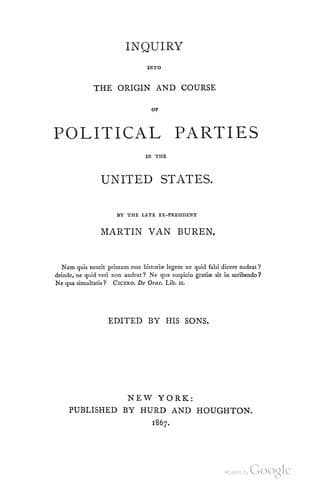
Inquiry Into the Origin and Course of Political Parties in the United StatesVan Buren, Martin
History
Inquiry Into the Origin and Course of Political Parties in the United States
Van Buren, Martin
Political parties -- United States
Mr. Jefferson, on the other hand, succeeded at the age of fourteen, in
addition to other rights of primogeniture, to an inheritance which, with
competent management, was sufficient to satisfy all his wants, and to a
social position, when he became a man, which required no pecuniary aids
to make his condition in every respect all that was desirable, and one
that could scarcely be improved by any change in the government of his
country. To an unusual extent devoid of the gift of oratory, personal
ambition was less likely to tempt him into the paths of politics.
Cherishing always a love of letters, science and the arts, blessed with
a genial temper, and in every respect well qualified to adorn and to
enjoy the social circle, he seemed destined for a life of elegant ease.
But, happily for the cause of human rights throughout the world, and for
the welfare especially of his own country, he was impressed by his Maker
with an ardent love of liberty, and a zealous devotion to the generous
and equalizing principles of republican government, which impelled him
into the political field, and placed him from the beginning in
unreserved hostility to hereditary political power in any form, to all
institutions in the State which secure to particular classes or
individuals a preference over others of equal merit, and to all power in
government, or in individuals or associations, civil or ecclesiastical,
which can be exerted to control the opinions or to coerce the
consciences of men.
Moved by such impulses, and having "sworn eternal hostility against
every form of tyranny over the mind of man," he entered, at an early
age, upon his public career, destined to be long and eventful, and
sustained throughout the character given of him on his first appearance
in Congress in 1775, by John Adams,--"prompt, frank, explicit, and
decisive"--"not even Samuel Adams was more so." From that time until the
day of his death he gave his support, never for a moment diminished in
zeal or sincerity, and varied only in its efficiency according to the
positions he occupied and the influence they afforded for the purpose,
to the great principle of "the equality of political rights" which
Hamilton well described as "the foundation of pure Republicanism."
Public-domain text, read in full here on John Shaqi.
Reviews
Reviews
No reviews yet
Be the first to share your thoughts on this work.
Elsewhere in the archive
Join the Discussion
Join the discussion
Sign in to leave a comment or review.
Sign InorCreate an account