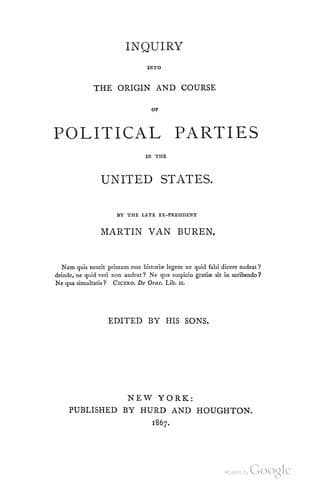
Inquiry Into the Origin and Course of Political Parties in the United StatesVan Buren, Martin
History
Inquiry Into the Origin and Course of Political Parties in the United States
Van Buren, Martin
Political parties -- United States
That Hamilton's settled opinion and preference were such as I have
described is a point which has been, it is hoped, already too well
established to admit, at this day, of an honest difference of opinion.
He avowed them on the floor of the Convention in the presence of the
assembled representatives, and this is equally clear, whether the sum of
that declaration is tested by the copy of the speech which he himself
delivered to Mr. Madison as a permanent record of his opinions, or by
the notes for that speech now published by his son. He announced them to
his political rival, Mr. Jefferson, in the presence of Mr. John Adams,
and reaffirmed them to the former in a conversation obviously sought for
the purpose of giving the form he desired to expressions of a less
guarded character, and which were, under that impression, immediately
reduced to writing by Mr. Jefferson, who, for the truth of his record,
"attests the God that made him." He so thoroughly impressed his
political coadjutor and most trusted friend--him to whom it was
appointed to pronounce his eulogy at his funeral--Gouverneur Morris,
with a sense of his devotion to monarchical institutions, that within
six months after his death, Morris, writing to his friend Ogden, speaks
of that devotion as "hobby" which Hamilton "bestrode to the great
annoyance of his friends, and not without injury to himself;" also to
Robert Walsh, the well-known editor of a leading Federal journal, in
answer to inquiries on the subject, that "Hamilton hated republican
government because he confounded it with democratical government, and he
detested the latter because he believed it must end in despotism, and be
in the mean time destructive to morality;" and that "he never failed on
every occasion to advocate the excellence of, and his attachment to,
monarchical government." It was in perfect keeping with the character of
Hamilton that never, throughout his life, though constantly charged with
entertaining such opinions, did he deny the imputation; he who denies it
now must assume that Hamilton either did not know his own mind upon the
subject, or that he had some motive for misrepresenting it, or that Mr.
Jefferson deliberately falsified his repeated declarations, and that
Gouverneur Morris was capable of misrepresenting his friend upon a point
of so much importance when that friend had descended to his grave.
To what lengths Hamilton would have gone to subvert the existing
government, and to substitute monarchical institutions, or under what
circumstances he would have deemed an attempt to do so justifiable, are
questions open to investigation and comment, but to discuss the fact of
his constant preference for such institutions, and desire to see them
established here, would be to trifle with the subject.
Public-domain text, read in full here on John Shaqi.
Reviews
Reviews
No reviews yet
Be the first to share your thoughts on this work.
Elsewhere in the archive
Join the Discussion
Join the discussion
Sign in to leave a comment or review.
Sign InorCreate an account