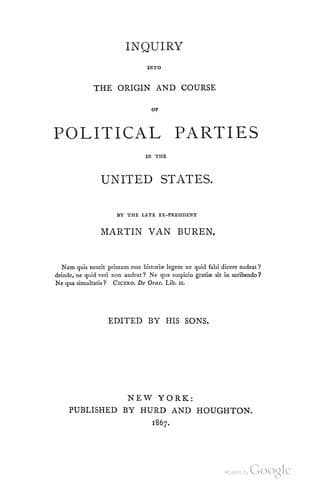
Inquiry Into the Origin and Course of Political Parties in the United StatesVan Buren, Martin
History
Inquiry Into the Origin and Course of Political Parties in the United States
Van Buren, Martin
Political parties -- United States
Mr. Adams, who was President, and in whose name the battle was fought,
fell but little if any thing short of General Hamilton in his partiality
for the English system. To purge the British Constitution of its
corruptions, and to give to its popular branch equality of
representation, were alone necessary, he thought, to make it "the most
perfect Constitution ever devised by the wit of man." The alterations or
amendments he suggested, sound and creditable to himself as they were,
were no more than qualifications of his general preference for the
English model. If Hamilton's admiration of that model was less qualified
than that of Adams, it must at the same time be admitted that the former
was freest from the fault of seeking to degrade and discredit republican
institutions by his writings. Without undertaking to describe the
specific design of Mr. Adams's "Defense of the Constitutions of
Government of the United States," or of his "Discourse on Davila,"--a
task, for obvious reasons, very difficult,--it may, I think, be safely
assumed that such was their manifest tendency. Hamilton at least thought
so at a time when the reciprocal prejudices which afterwards separated
them so widely had not yet acquired a strong hold upon the feelings of
either. In his interview with Mr. Jefferson on the 13th of August, 1791,
before referred to, when the conversation was turned to the writings of
Mr. Adams, Hamilton condemned them, and "most particularly Davila, as
having a tendency to weaken the present Government;" and, after other
remarks in relation to the existing Government and its chances of
success, he added,--"Whoever by his writings disturbs the present order
of things is really blamable, however pure his intentions might be, and
he was sure Mr. Adams's were pure."
The division by Mr. Adams of governments designated as republics, into
democratic republics, aristocratic republics and monarchical, or regal
republics,--embracing a minute description of each, in which the
Government of the "United Provinces of the Low Countries," whose powers
are held by the persons intrusted with them either by hereditary title
or by the selection of associates, after the manlier of close
corporations, is called a "democratic Republic," and that of England a
"monarchical, or regal Republic,"--was naturally displeasing to the
sense and feeling of those who regarded aristocratical or monarchical or
regal features as absolutely incompatible with the true idea of
republican government. The voluminous and doubtless violent attacks that
were made upon his writings were scarcely necessary to satisfy those who
had freely undergone the sufferings and sacrifices of a long and bloody
war to secure to themselves and their posterity the blessings of
republican institutions, according to their acceptation of them, that
the writings of Mr. Adams were designed, as was charged, to cause the
term "Republican Government" to mean "any thing or nothing."
Public-domain text, read in full here on John Shaqi.
Reviews
Reviews
No reviews yet
Be the first to share your thoughts on this work.
Elsewhere in the archive
Join the Discussion
Join the discussion
Sign in to leave a comment or review.
Sign InorCreate an account