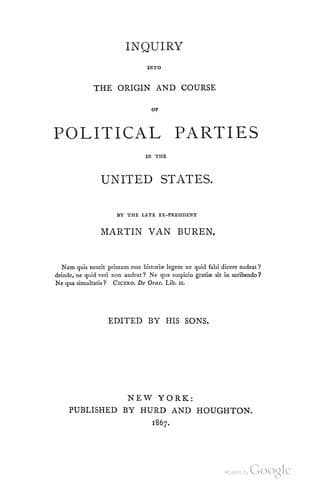
Inquiry Into the Origin and Course of Political Parties in the United StatesVan Buren, Martin
History
Inquiry Into the Origin and Course of Political Parties in the United States
Van Buren, Martin
Political parties -- United States
The notices taken of the general subject and of these writings in
particular, by John Adams himself, by his son, John Quincy Adams, and by
his grandson, Charles Francis Adams, go far to show that if not fairly
liable to this construction, they were too much open to it to be
persisted in. In a note attached by the author, in 1812, to the
"Discourse on Davila," as published in his "Life and Works," he says:
"The work, however, powerfully operated upon his (J. A.'s) popularity.
It was urged as full proof that he was an advocate for monarchy, and
laboring to introduce a hereditary President in the United States." His
grandson, Charles F. Adams, introducing the "Discourse" in his "Life and
Works of John Adams," says: "They furnished to the partisans of the day
so much material for immediate political use in the contest then
beginning (1790), that the author thought it best to desist, and they
were left incomplete."
John Quincy Adams, in his Jubilee Address,--the occasion and character
of which have been heretofore noticed,--describes the state of parties
at the accession of General Washington to the Presidency in the
following terms: "On the other hand no small number of the Federalists,
sickened by the wretched and ignominious failure of the Articles of
Confederation to fulfill the promise of the Revolution; provoked at once
and discouraged by the violence and rancor of the opposition against
their strenuous and toilsome endeavors to raise their country from her
state of prostration; chafed and goaded by the misrepresentations of
their motives, and the reproaches of their adversaries, and imputing to
them in turn deliberate and settled purposes to dissolve the Union and
resort to anarchy for the repair of ruined fortunes,--distrusted ever
the efficacy of the Constitution itself, and with a weakened confidence
in the virtue of the people were inclined to the opinion that the only
practicable substitute for it would be a government of greater energy
than that presented by the Convention. There were among them numerous
warm admirers of the British Constitution, disposed to confide rather to
the inherent strength of the Government than to the self-evident truths
of the Declaration of Independence for the preservation of the rights of
property and perhaps of persons."
Public-domain text, read in full here on John Shaqi.
Reviews
Reviews
No reviews yet
Be the first to share your thoughts on this work.
Elsewhere in the archive
Join the Discussion
Join the discussion
Sign in to leave a comment or review.
Sign InorCreate an account