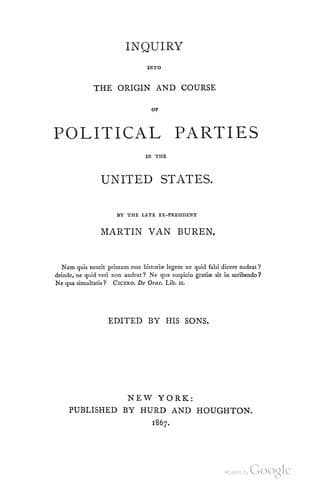
Inquiry Into the Origin and Course of Political Parties in the United StatesVan Buren, Martin
History
Inquiry Into the Origin and Course of Political Parties in the United States
Van Buren, Martin
Political parties -- United States
John Adams's "Defense" and "Discourse" were written at different periods
remote from each other, and when he himself occupied very different
situations; the former before the formation of the Federal Constitution,
when he represented his country as Minister to England, and the latter,
which was universally regarded as the most Anti-Republican of the two,
after he had been elected Vice-President. That his views were in some
degree changed by time and circumstances is not improbable. Mr.
Jefferson thought that he owed his support for the Vice-Presidency to
the Anti-Republican tendencies of the first work, and that his election
to that office and the federal sentiment that he found prevalent on his
return from England, and down to the commencement of the new government,
induced him to write the "Discourse," and to give to it a higher tone in
the same direction. The diffusive and (if that expression is not too
strong when speaking of writings of so much learning and ability) the
incoherent manner in which these works were constructed, particularly
the earlier one, makes it unsafe to venture to specify the precise
principles they were designed to sustain. His grandson was so sensible
of the deficiencies of the "Defense" in these respects that he
reconstructed and improved it in his publication, but without, as he
says, changing the sense, and I have no doubt that he has carried out
the latter idea in good faith.
That few if any American citizens went beyond John Adams in his
admiration of the British Constitution is undeniably true. In the third
chapter of the "Defense,"--(see Vol. IV. p. 358, of his "Life and
Works,") he pronounces an eulogium on that Constitution which goes far
beyond that reported by Mr. Jefferson, (in his account of the
conversation between Adams and Hamilton in April, 1791,) calling it "the
most stupendous fabric of human invention," adding, that "not the
formation of languages, not the whole art of navigation and
ship-building, does more honor to the human understanding than this
system of government." But on the very next page he commends the United
States for not having followed the English model, so far as to make
"their first magistrates or their senators hereditary"--differing
substantially in that regard from the opinion reported by Mr. Jefferson,
and showing how unsafe if not futile would be the attempt to define
exactly the principles which he favored.
Public-domain text, read in full here on John Shaqi.
Reviews
Reviews
No reviews yet
Be the first to share your thoughts on this work.
Elsewhere in the archive
Join the Discussion
Join the discussion
Sign in to leave a comment or review.
Sign InorCreate an account