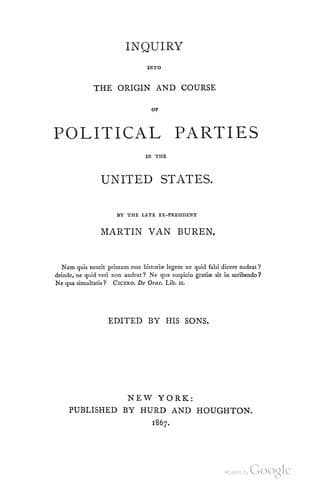
Inquiry Into the Origin and Course of Political Parties in the United StatesVan Buren, Martin
History
Inquiry Into the Origin and Course of Political Parties in the United States
Van Buren, Martin
Political parties -- United States
It may, notwithstanding, be safely assumed, _first_, that he was
foremost among the warm admirers of the British Constitution spoken of
by his son, and _secondly_, that he deemed our Constitution defective in
omitting to provide for some depository of political power in the
government, variant in principle from its general provisions, one which
should be either not at all or only very remotely subject to popular
control, and that he stood almost at the head of those whose confidence
in the virtue of the people had been greatly weakened by occurrences
following the Revolution.
The latter assumption would seem very fully warranted by the following
citations from his "Defense:"[30]
"The proposition, that the people are the best keepers of their own
liberties, is not true; they are the worst conceivable; they are no
keepers at all; they can neither judge, act, think, or will as a
political body."
"If it is meant by our author a representative assembly, they are not
still the best keepers of the liberties of the people; at least the
majority would invade the liberty of the minority sooner and oftener
than an absolute monarchy."
"A great writer has said that a people will never oppress themselves, or
invade their own rights. This compliment, if applied to any nation or
people in being or memory, is more than has been merited."
"Aristides, Fabricius, and Cincinnatus, are always quoted, as if such
characters were always to be found in sufficient numbers to protect
liberty; and a cry and show of liberty is set up by the profligate and
abandoned, such as would sell their fathers, their country, and their
God for profit, place, and power. Hypocrisy, simulation, and finesse are
not more practiced in the courts of princes than in popular elections,
nor more encouraged by kings than people."
"The real merit of public men is rarely known and impartially
considered. When men arise who to real services add political
empiricism, conform to the errors of the people, comply with their
prejudices, gain their hearts and excite their enthusiasm, then
gratitude is a contagion--it is a whirlwind."
[30] See Randall's _Life of Jefferson_, Vol. I. p. 587.
The same volume (of Randall's Work) contains copious extracts from the
letters of Fisher Ames and a number of other leading Federalists,
derived from Hamilton's recently published papers and other sources.
They breathe in general the same spirit, hankering after
pre-revolutionary institutions and systems, though less boldly expressed
than was done by Hamilton and Adams, and the same distrust of the
sufficiency of the Constitution and above all of the capacities and
dispositions of the people, the latter exhibited in assaults upon
democracy and the democratic spirit of the country.
Public-domain text, read in full here on John Shaqi.
Reviews
Reviews
No reviews yet
Be the first to share your thoughts on this work.
Elsewhere in the archive
Join the Discussion
Join the discussion
Sign in to leave a comment or review.
Sign InorCreate an account