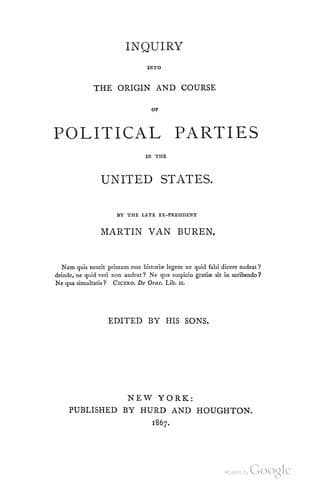
Inquiry Into the Origin and Course of Political Parties in the United StatesVan Buren, Martin
History
Inquiry Into the Origin and Course of Political Parties in the United States
Van Buren, Martin
Political parties -- United States
John Adams was in every sense a remarkable man. Nature seems to have
employed in his construction intellectual materials sufficient to have
furnished many minds respectably. It would not be easy to name men,
either of his day or of any period, whose characters present a deeper or
a stronger soil, one which during his long and somewhat boisterous
public life was thoroughly probed by his enemies without disclosing any
variation in its depths from the qualities and indications of its
surface. Still more deeply was it turned up and exposed to the light by
himself with the same result. His writings, which have been more
extensive and more various than those of any of his contemporaries, have
been given to the world apparently without reserve. These, with his
diaries and autobiography, have turned his character inside out and
shown us, without disguise of any sort, the kind of man he was: and the
representation is invariably that of the same "always honest man" that
he was three quarters of a century ago when that high praise was
accorded to him by his not too partial friend, Benjamin Franklin, in a
communication not designed to be over civil.
Whatever diversities may have arisen in the opinions of men in relation
to the merits or demerits of his after conduct, all agree in conceding
to him credit for patriotic and useful services in the times which have
been happily described as those which tried men's souls. Mr. Jefferson,
but two years before the death of both of them, on referring to that
period, and to Mr. Adams's great services, in my presence, was warmed by
the subject, and spoke of him as having been the mainmast of the
ship--the orator of the Revolution, &c. It is in all probability no
exaggeration of his merits to assume that there was no man in the United
States, (perhaps, but not without doubt, excepting Samuel Adams,) who,
before he was sent abroad in their service, did more than himself in a
civil capacity to promote the cause of the Revolution. This is a high
distinction--one which entitles his memory to the perpetual reverence of
his countrymen. No subsequent errors of opinion, nothing short of
personal dishonor and degradation, of which he was incapable, could
extinguish a claim to the enduring gratitude and respect of a nation
founded on such services.
Public-domain text, read in full here on John Shaqi.
Reviews
Reviews
No reviews yet
Be the first to share your thoughts on this work.
Elsewhere in the archive
Join the Discussion
Join the discussion
Sign in to leave a comment or review.
Sign InorCreate an account