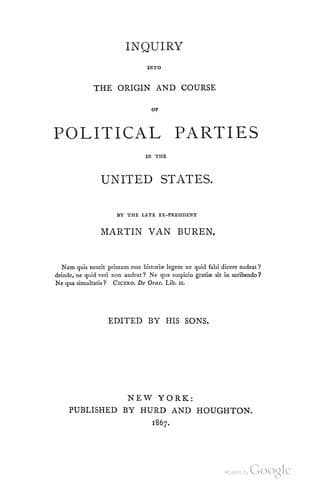
Inquiry Into the Origin and Course of Political Parties in the United States — John Shaqi
Inquiry Into the Origin and Course of Political Parties in the United StatesVan Buren, Martin
History
Inquiry Into the Origin and Course of Political Parties in the United States
Van Buren, Martin
Political parties -- United States
These and kindred feelings and principles were, as I have said, natural
to men whose antecedents, as well as those of their ancestors, had been
such as I have described; and they remained throughout the prevailing
features of colonial politics. They were not only the views of men
prominent in their respective communities, but the matured convictions
of the masses in respect to the line of policy necessary to their
welfare, and therefore the more likely to be perpetuated, for it has
been well and truly said, that "it is the masses alone that live." These
opinions might occasionally and for a season lie dormant, or be made to
yield to power, but neither corruption nor force could eradicate them.
With occasional but brief intermissions, they controlled the action of
the colonial legislatures; were embraced by a majority of the signers of
the Declaration of Independence; directed the course of the
Revolutionary Congress as well as that of the Government of the
Confederation subsequent to the recognition of our Independence, and
were in truth always the real sentiments of a majority of the people.
It will be hereafter seen when they were for a season rendered
powerless, and when and how their control over the action of the
government was restored.
The materials for tracing the action of the public mind, and the
proceedings of public bodies during the early periods of our history,
are, in comparison with those applicable to modern times, quite
imperfect. But aided by the facts which the historians of our day, with
great industry and in most cases with equal fidelity, have drawn from
oblivion, and still more by the recent very general publication of the
papers of eminent deceased statesmen, the work has become less
difficult.
The fidelity of the Puritans to their well-known principles in respect
to hereditary power, was soon exposed to a severe trial. During the
residence of Sir Henry Vane in the Colony of Massachusetts, several
English peers, induced by a desire to remove to that colony and to make
it their place of permanent residence, offered to do so if changes could
be effected in its government, by which the General Court should be
divided into two bodies, and their hereditary right to seats in the
upper branch allowed to them. Strong as was the wish of the colonists
for the acquisition of those distinguished men, they yet declined a
compliance with their wishes. All that they could be induced to allow
was a life-tenure, and they actually made some appointments of that
character; but of this they soon repented, and attached to the offices
held by that tenure a condition which made the concession nugatory by
making it valueless. It is perhaps not assuming too much to suppose that
the regret they experienced at this momentary forgetfulness of their
principles--a regret exhibited in various ways--had no small influence
in inducing them to limit the terms of offices in the New England States
to very short periods, as is still the custom there.
Public-domain text, read in full here on John Shaqi.
Reviews
Reviews
No reviews yet
Be the first to share your thoughts on this work.
Join the Discussion
Join the discussion
Sign in to leave a comment or review.
Sign InorCreate an account