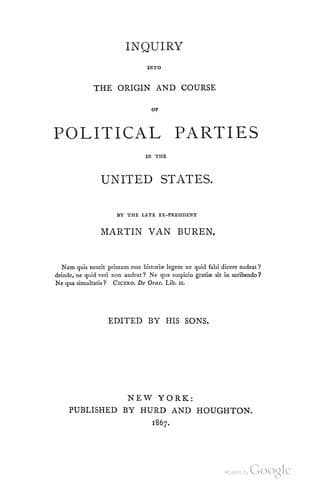
Inquiry Into the Origin and Course of Political Parties in the United StatesVan Buren, Martin
History
Inquiry Into the Origin and Course of Political Parties in the United States
Van Buren, Martin
Political parties -- United States
With the authentic record before us of the issue, the contest, the
result, and the efforts on the part of the defeated party to recover the
ground it had lost, the supposition seems preposterous that our party
divisions had their origin in the circumstances that occurred on the
appointment of General Washington to be Commander-in-Chief of our
Revolutionary army, as is alleged by a son of General Hamilton, in his
history of the life of his father. Of the same character, though not
quite so unreasonable, are the attempts which have been made by several
to find their origin in the Federal Convention. That body did indeed
present an occasion for the application of different opinions to the
original formation of the Federal Constitution, but those opinions grew
out of conflicting tenets which had divided the country into parties
long before, and they were not then determined either way, but
compromised upon grounds of expediency by a result which was not in
point of fact satisfactory to any side, but acquiesced in by a majority
obtained from the ranks of both. The proposition of President John
Quincy Adams in his Inaugural Address, tracing their rise to the
opposing sides taken by the people of the United States, as between
England and France, and their final discontinuance to the disastrous
career and termination of the French Revolution, would seem to be not
less wide of the mark. The continuance of the two great parties of the
country in the same state, in respect to the principles they espoused
and the characters and dispositions of those who composed them, for more
than half a century and for a quarter of a century before his address
was delivered, is not to be denied. If it was even supposed possible
that an intelligent and high spirited people like our own, with
traditions and a history so eventful, and with domestic interests so
important, could have been arrayed in hostile political opinions and
party divisions by the influence of purely foreign questions, the
continuance of those divisions in the same form and spirit for so many
years after all pretense of the operation of such an influence had
ceased would of itself be sufficient to refute the theory. But the
objections to it are too numerous, too conclusive in their character,
and too obvious to make it necessary to press them farther. The French
Revolution had sufficiently developed itself to weaken, if not
extinguish, the solicitude of the Republicans for its success, (who,
with their leader, Thomas Jefferson, regarded its excesses with
abhorrence,) before they expelled John Adams from the Presidency for the
aid and sanction which he gave to Hamilton's violations of the
Constitution, and his son, John Quincy Adams, was twenty-eight years
afterwards driven from power for the same cause and by the same party, a
party which he supposed had ceased to exist for some thirty years
previous. It was by his latitudinarian avowals in respect to the
Public-domain text, read in full here on John Shaqi.
Reviews
Reviews
No reviews yet
Be the first to share your thoughts on this work.
Elsewhere in the archive
Join the Discussion
Join the discussion
Sign in to leave a comment or review.
Sign InorCreate an account