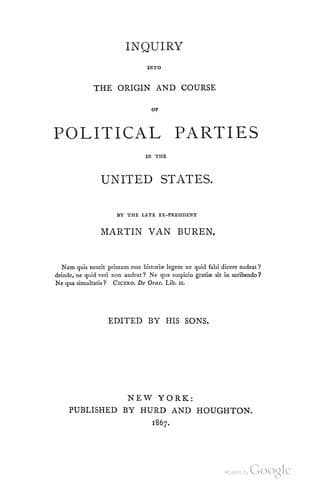
Inquiry Into the Origin and Course of Political Parties in the United StatesVan Buren, Martin
History
Inquiry Into the Origin and Course of Political Parties in the United States
Van Buren, Martin
Political parties -- United States
constitutional powers of Congress,--when he began to talk of erecting
"light-houses of the skies," and of the folly of paralyzing
representatives by the will of their constituents,--that his political
destiny was sealed.
That existing political divisions among the people of the United States
induced the formation of preferences and prejudices in respect to
England and France, was, doubtless, true, but to suppose that these
constituted the foundation of their own divisions is to mistake for the
cause one of its least important effects.
The Anti-Federal, Republican, and Democratic parties have been from the
beginning composed of men entertaining the same general views in regard
to the most desirable form of government, and to the spirit in which,
and the objects for which, it should be administered. The morbid
feelings of large portions of the old Anti-Federalists produced by their
distrust of delegated power, founded on their knowledge of the extent to
which it had been everywhere abused, led to a difference between them
and the Republicans on the question of clothing the Federal Government
with power to collect its own revenues, to regulate commerce, &c., and
induced them to oppose the ratification of the new Constitution on that
account, and on account of its deficiencies in regard to proper
securities for personal rights. Their party was thereby broken down, but
Jefferson and Samuel Adams, and men like them, succeeded in satisfying
them of their error in respect to the outlines of the Constitution, and
Madison procured the adoption of amendments that obviated their other
objections and, as I have before said, a cordial and enduring union was
formed between them and the Republicans, under the latter name. Since
that period the party has undergone no change, either in its
organization, its principles, or the general political dispositions of
the individuals of which it has been composed. Its name has been changed
from Republican to Democratic, in consequence of the increasing popular
development of its course and principles, and in some degree by the
circumstance that its old opponent had assumed the name of Federal
Republican and by a natural desire to keep the line of demarcation
between them as broad and as well defined as possible.
Public-domain text, read in full here on John Shaqi.
Reviews
Reviews
No reviews yet
Be the first to share your thoughts on this work.
Elsewhere in the archive
Join the Discussion
Join the discussion
Sign in to leave a comment or review.
Sign InorCreate an account