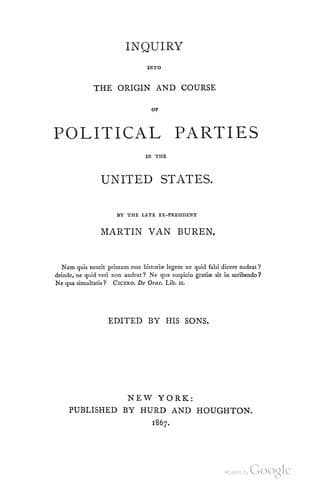
Inquiry Into the Origin and Course of Political Parties in the United StatesVan Buren, Martin
History
Inquiry Into the Origin and Course of Political Parties in the United States
Van Buren, Martin
Political parties -- United States
Among the "_midnight appointments_" by President Adams, (a stigma
attached to them at the time, and from which they have never been
rescued,) were forty-two magistrates, nominated for the District of
Columbia. The list, though containing many highly respectable names,
was in the main made up of opponents of the President elect, not a few
of them strongly imbued with the partisan _furor_ of the day. They were
to hold their offices for a period extending beyond that for which the
President himself was elected, and it was upon their coöperation Mr.
Adams and his cabinet intended that his successor should be mainly
dependent for the discharge of the high duty imposed upon him by the
Constitution--that of causing the laws to be executed in the Federal
District. The nominations were sent to the Senate on the second of
March, confirmed during the night of the third, and Mr. Jefferson
entered upon the duties of his office the next morning. The commissions
were found on the table in the State Department with its seal attached,
signed by President Adams, and if signed also by a Secretary it must
have been by a _locum tenens_, as Mr. Marshall had some days before been
transferred from the office of Secretary of State to that of Chief
Justice of the Supreme Court of the United States. The commissions had
not been delivered,--an act which Mr. Jefferson, as the head of the
executive department of the Government, decided to be necessary to the
completion of the appointment. Under such circumstances, and, doubtless,
stung by the ungraciousness of the treatment he had received, he
directed that the commissions should neither be recorded nor delivered,
but treated as nullities. Believing the number far too large, he issued
new commissions during the recess to twenty of those selected by Mr.
Adams and to five others designated by himself, nominated them to the
Senate at its next session, by which body they were confirmed.
This transaction furnished the desired occasion to apply the opening
wedge for the enlargement of the judicial power of the Federal
Government, and it was promptly and fully embraced through the
proceedings that were had in the celebrated case of Marbury and Madison.
The judges of the Supreme Court were to a man Federalists, and at the
head of them stood, as chief justice, President Jefferson's persevering
and consistent old political antagonist--John Marshall.
Public-domain text, read in full here on John Shaqi.
Reviews
Reviews
No reviews yet
Be the first to share your thoughts on this work.
Elsewhere in the archive
Join the Discussion
Join the discussion
Sign in to leave a comment or review.
Sign InorCreate an account