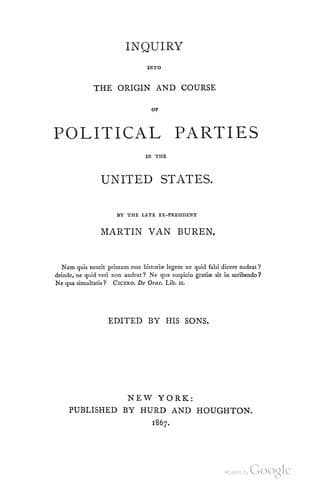
Inquiry Into the Origin and Course of Political Parties in the United StatesVan Buren, Martin
History
Inquiry Into the Origin and Course of Political Parties in the United States
Van Buren, Martin
Political parties -- United States
The Chief Justice may not have been the severest student or the most
learned lawyer, but he was certainly, all things considered, the ablest
judge that had ever occupied a seat upon the bench of the Supreme Court
of the United States. No man was ever more rigidly just or strictly
impartial in all cases of _meum and tuum_ that were brought before him
for adjudication. Under a disposition the most genial, and a childlike
simplicity and frankness of manner he cherished during his whole life,
as all his race have done, Federal principles and Federal prejudices of
the most ultra character. These, though ordinarily kept in due check by
a commendable and exemplary self-command,--a virtue he shared with, if
he had not in some degree imbibed it from, his friend and neighbor,
General Washington,--had nevertheless been warmed by the circumstances
of the moment to a high temperature. The inducements by which he was
almost forced into public life by the General, shortly before the death
of the latter, have been narrated in the account I have given of my
conversation with his nephew, Judge Washington, at Mount Vernon.[32]
Unhappily impressed with the idea that his own as well as the interests
of the country depended upon the support of Mr. Adams' administration,
General Washington for once, and fortunately only for a brief season,
lent himself to partisan movements and used his controlling influence to
induce Mr. Marshall to offer for Congress, and in no other case has the
high estimate he formed of a man's capacity been more signally verified
by the result. Marshall became at once, through the influence of a
single speech of extraordinary power, a leader in the House of
Representatives during the most stormy period of the administration of
John Adams, was subsequently appointed Secretary of War and Secretary of
State by Mr. Adams, and held the latter office until his party, and the
administration with it, were overthrown by the Republicans under the
lead of Mr. Jefferson. He was then transferred by Mr. Adams to the place
of Chief Justice. Other circumstances lent their influence to infuse
ill-will into the personal relations of Jefferson and Marshall. They
were natives of the same State, and although they had stood as Whigs
side by side in the Revolution, the political principles maintained by
Mr. Jefferson, after the establishment of our Independence, were so much
more in harmony with those of Virginia as to place Marshall's views ever
after under the ban of her opinion, notwithstanding the qualified
sanction they received front General Washington. On the part of Mr.
Jefferson, the unfriendly feelings which he believed were entertained
toward him by the Chief Justice were, for him, quite earnestly
reciprocated. This is shown by the following pointed extract from his
letter to myself, in which, speaking of the alterations and other uses
that had been made of his letter to Mazzei, he adds, "and even Judge
Public-domain text, read in full here on John Shaqi.
Reviews
Reviews
No reviews yet
Be the first to share your thoughts on this work.
Elsewhere in the archive
Join the Discussion
Join the discussion
Sign in to leave a comment or review.
Sign InorCreate an account