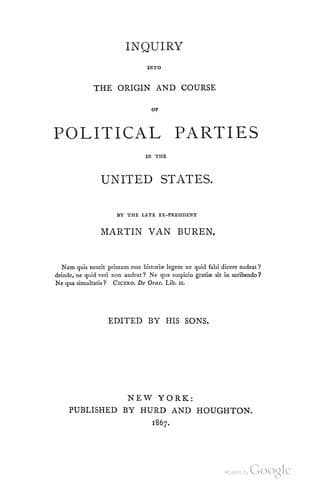
Inquiry Into the Origin and Course of Political Parties in the United StatesVan Buren, Martin
History
Inquiry Into the Origin and Course of Political Parties in the United States
Van Buren, Martin
Political parties -- United States
Marshall makes history descend from its dignity and the ermine from its
sanctity to exaggerate, to record, and to sanction this forgery."[33]
[32] See Note on p. 9.
[33] See Appendix.
Mr. Jefferson, apprised that steps were being taken to bring his acts in
respect to the commissions under the supervision of the Supreme Court,
at once penetrated the design that lay behind the particular measure,
and, with that moral courage that never deserted him, prepared to defend
the department committed to his charge. The head of the State
Department was advised, and the clerks instructed, to make themselves
parties to no act which would justly be regarded as recognizing the
authority of the court to meddle in the affair, and his views were, of
course, faithfully carried out by Mr. Madison, as well as by the
subordinates in the department. A motion was made at the December term
of the court in 1801, for a rule requiring James Madison to show cause
why a mandamus should not issue commanding him to deliver those
commissions to the nominees. Notice of motion was served upon Mr.
Madison, but he declined to appear. He was asked by the relator whether
the commissions were signed and sealed, but declined to respond to such
inquiries, as did also the officers of the department. Application was
also made to the Secretary of the Senate for a certificate that the
nominations had been confirmed, which was also refused. A resolution was
offered in the Senate directing the Secretary of the Senate to give the
certificate. It was laid upon the table and no further acted upon. Upon
affidavits stating these facts, except the last, a rule was obtained
requiring the Secretary to show cause why the mandamus should not be
issued on a day certain, of which he took no notice. The court,
notwithstanding, proceeded to an _ex parte_ hearing. "Two clerks were
summoned from the department as witnesses, who objected to be sworn
because they were not bound to disclose any facts relating to the
business or transactions of the office. The court ordered the witnesses
to be sworn, and their testimony taken in writing; but informed them
that, when the questions were asked, they might state their objections
to answering each particular question, if they had any. Mr. Lincoln, who
had been Acting Secretary of State when the circumstances stated in the
affidavits occurred, was called upon to give testimony. He objected to
answering. The questions were put in writing. The Court said there was
nothing confidential required to be disclosed. If there had been, he was
not obliged to answer that, nor was he obliged to state any thing which
would criminate himself."[34]
[34] Taken from the report of the case.
The testimony that was given is not set forth in the report of the case.
The counsel for the relator argued the questions he presented for the
consideration of the court in the following order, viz.:
1st. Whether the Supreme Court can award the writ of mandamus in any
case.
Public-domain text, read in full here on John Shaqi.
Reviews
Reviews
No reviews yet
Be the first to share your thoughts on this work.
Elsewhere in the archive
Join the Discussion
Join the discussion
Sign in to leave a comment or review.
Sign InorCreate an account