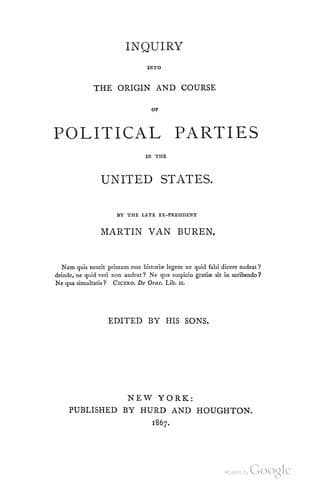
Inquiry Into the Origin and Course of Political Parties in the United StatesVan Buren, Martin
History
Inquiry Into the Origin and Course of Political Parties in the United States
Van Buren, Martin
Political parties -- United States
Both branches of the jurisdiction in these respects taken collectively,
their results would not have been any thing like the power and influence
and dignity which the Supreme Court of the United States derived from a
single clause in the Judiciary Act of 1789, extending its appellate
jurisdiction to the decisions of the State courts. The assemblage of
cases for its application arrayed in that pregnant section, aided by the
power derived from the construction given to the provision in the
Federal Constitution prohibiting the passage of State laws violating the
obligation of contracts--a provision always understood to have been
introduced to prevent State obstructions to the collection of British
debts, but now made to override the insolvent systems of the States,
etc.,--gave the Supreme Court the supervision and control of the most
valuable and hitherto the most cherished portion of the legislation and
jurisprudence of the State governments. To secure this control was an
object always near to Hamilton's heart. He attempted it openly in the
Convention by his proposition for a negative upon State laws, etc. But
in the hands of the court the control of the Federal Government over
State legislation was equally effective, less likely to become
obnoxious, and infinitely more secure; for if it had been placed, as he
proposed, in the hands of the President, or of the President and Senate,
or of Congress, it would still have been deposited in places accessible
to the people, and at short and stated periods liable to be overruled by
their will. But here it was in the only sanctuary in a republican
government he deemed safe against popular inroads, and it was this
provision _in the Judiciary Act_ which, more than all other things
combined, made that department--which Montesquieu described as next to
nothing in point of power, and upon the weakness of which Hamilton,
before the passage of that act, descanted so freely--the most formidable
and overshadowing branch of the government. The section bears the
impress of his mind, and if not the work of his pen was beyond all doubt
the result of his suggestions. Hamilton was not a member then, but we
have seen that he made speeches in Congress through another, and I have
not a doubt that, if the truth could now be known, it would appear that
but few things were said or done on one side, in either branch of that
body, of which he did not make a part in some form. Is it not passing
strange that not a word is to be found in the Constitution to authorize
Congress to confer such a jurisdiction upon the Supreme Court? Can it be
for a moment supposed that such a power,--one so nearly akin to the
proposition to place a veto in the hands of the Federal Government upon
State legislation, one so eminently calculated to alarm the State-rights
party,--would have been allowed, if it had been by anybody believed to
be in the Constitution, to pass the State Conventions _sub silentio_?
Public-domain text, read in full here on John Shaqi.
Reviews
Reviews
No reviews yet
Be the first to share your thoughts on this work.
Elsewhere in the archive
Join the Discussion
Join the discussion
Sign in to leave a comment or review.
Sign InorCreate an account