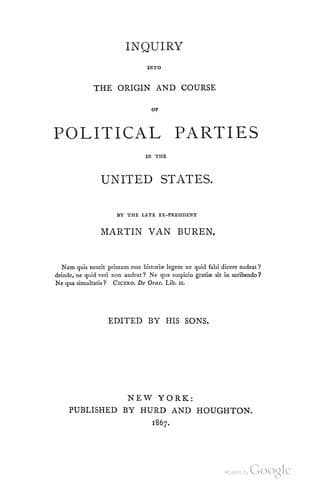
Inquiry Into the Origin and Course of Political Parties in the United StatesVan Buren, Martin
History
Inquiry Into the Origin and Course of Political Parties in the United States
Van Buren, Martin
Political parties -- United States
What is said in the Constitution about the appellate jurisdiction of the
Supreme Court is not only satisfied by referring it to the inferior
courts which Congress were authorized to "ordain and establish," but is,
by the terms employed, fairly confined to them. The place in the
Constitution where the authority is given to establish inferior courts
to exercise those parts of the judicial power of which no original
jurisdiction was given to the Supreme Court, and which were to
constitute the basis for the operation of that which was to be appellate
only, would have been, one would suppose, the very place in which the
authority to extend that jurisdiction to the State courts would have
been inserted if it was intended to be given. Again, the whole judicial
power of the United States is by the Constitution vested in the Supreme
Court, and in _such inferior courts as the Congress may from time to
time ordain and establish_. That the words used embrace, and seem
intended to embrace, the _whole power_, is apparent from the face of the
Constitution, and was, besides, demonstrated by Hamilton in the first
number of his "Pacificus." Madison said in the Virginia Convention, that
it would be in the power of Congress to _vest the inferior Federal
jurisdiction in the State courts_; and Pendleton and Mason intimated an
expectation that this would be done; whilst Grayson said that State
judges formed the principal defense of the rights of the States, and
that Congress should not take from them their "only defensive armor;"
and Patrick Henry, who in the days of his political orthodoxy could
snuff danger to State rights in almost every breeze, apprehended that
"by construction the Supreme Court would completely annihilate the State
courts." Had Congress invested the inferior Federal jurisdiction in the
State courts, and had they accepted the extension, the appellate
jurisdiction of the Supreme Court to those courts in the cases
enumerated would have been in all respects proper. But the Congress, a
majority of whose members were Hamiltonian Federalists, were not, for
reasons it is now unnecessary to consider, willing to admit the State
courts to a participation in the administration of the judicial power
reserved to the Federal Government, and proceeded at once to ordain and
establish inferior courts of their own. These consisting of district
courts, circuit courts and the one Supreme Court named in the
Constitution, completed the organization of the Federal judiciary. Their
respective jurisdictions were wisely separated and accurately defined. A
small portion of that which was original was, for well-understood
reasons, vested in the Supreme Court. The residue was separated and
distributed among the inferior tribunals, subject to an appellate
jurisdiction and supervisory power in the Supreme Court over all their
proceedings. The system thus arranged was not only complete but
harmonious in all its parts. The courts were clothed with the entire
Public-domain text, read in full here on John Shaqi.
Reviews
Reviews
No reviews yet
Be the first to share your thoughts on this work.
Elsewhere in the archive
Join the Discussion
Join the discussion
Sign in to leave a comment or review.
Sign InorCreate an account