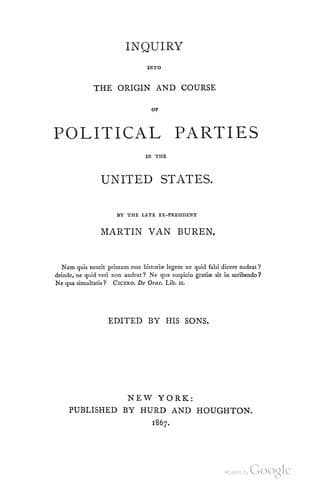
Inquiry Into the Origin and Course of Political Parties in the United StatesVan Buren, Martin
History
Inquiry Into the Origin and Course of Political Parties in the United States
Van Buren, Martin
Political parties -- United States
The few members of that Congress who had not been entirely carried away
by this current, and had the boldness to stand by the States and their
tribunals--among whom that firm and incorruptible republican, James
Jackson of Georgia, was by far the most effective--were willing that a
right to supervise and reverse the decisions of the State tribunals in
all matters of Federal jurisdiction, should be conferred on the Supreme
Court of the United States, provided only that the State courts were
intrusted, as they had hitherto been, with the administration of the
inferior Federal jurisdiction in lieu of the inferior Federal courts
which the Bill proposed to establish. This they contended would make the
system an harmonious and consistent one, and preserve the respect and
consideration which was due to the State tribunals.
The proposition was literally scouted in debate and rejected by a vote
of two to one in the House, and in the Senate by a still larger
majority. The Bill was so constructed as to clothe the Supreme Court and
the inferior courts it established with all the judicial power allowed
to the Federal Government by the Constitution, with unimportant
reservations which did not diminish their authority and do not require
to be noticed. Ample means were thus provided for its practical
extension to every party entitled to its protection, and if those who
regulated the action of Congress had not been influenced by any views
other than such as related to the administration of justice, its
legislation would have terminated there. But that body went further. A
clause was added to the Judiciary Bill professing to give to the Supreme
Court appellate jurisdiction over the final judgments and decrees of the
highest courts of law and equity of a State, whoever might be the
parties to the suit, or whatever might have been the objects for which
it had been brought, provided only that the relative powers of the
Federal and State governments under the Federal Constitution in respect
to several enumerated subjects had in the course of prosecution of such
suit been "drawn in question," and decided against the Federal power. No
matter to what extent the rights of the parties were concluded by that
question, or in what form or how incidentally it had been introduced, it
was sufficient that it had been raised and decided against the Federal,
or in favor of the State authority, to subject the judgment or decree
given by the State court to be reëxamined or reversed in the Supreme
Court of the United States. To confer upon that tribunal, the anomalous
authority of issuing writs of error to the highest courts of other
States confessedly sovereign, and which in all such matters might well
be regarded as foreign States,--courts which were not established by the
Federal Government, and between which and it there existed no judicial
relations,--commanding those courts to send to it for reëxamination,
reversal, or affirmance, the record of judgments and decrees which had
Public-domain text, read in full here on John Shaqi.
Reviews
Reviews
No reviews yet
Be the first to share your thoughts on this work.
Elsewhere in the archive
Join the Discussion
Join the discussion
Sign in to leave a comment or review.
Sign InorCreate an account