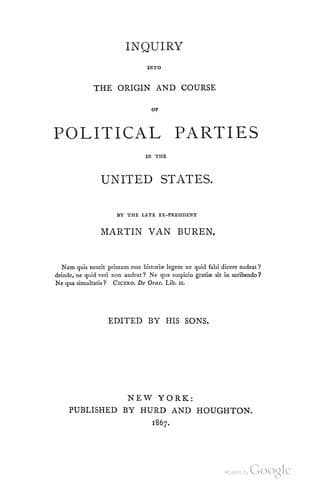
Inquiry Into the Origin and Course of Political Parties in the United StatesVan Buren, Martin
History
Inquiry Into the Origin and Course of Political Parties in the United States
Van Buren, Martin
Political parties -- United States
Theophilus Parsons of Massachusetts, Tappan Reeves of Connecticut, and
Pendleton, Wythe and Roane of Virginia, with numerous others, might be
added to the list. It would not be an easy matter to match these by
selections from the bench of the Supreme Court of the United States,
highly distinguished as its incumbents have been.
The State courts had, for nearly fifteen years before the passage of the
Judiciary Act of 1789, performed, as well in peace as in war, most of
the duties which the new Constitution devolved upon the Federal
judiciary. The Federal Government was authorized, by the articles of
Confederation, to establish inferior courts for the trial of piracies
and felonies committed on the high seas, and courts for the trial of
Admiralty cases, yet these powers had been carried into effect through
the State judiciaries. But all at once the State courts were deemed
unworthy of trust. Whence this change? Had the State courts degenerated?
No such thing; they were constantly improving, the supineness of a few
in respect to the interests of the mother country, blamable as it
certainly was, to the contrary notwithstanding. No, the State courts had
not become worse, but the implacable opponents of those whose judicial
power they represented had become stronger! The old Anti-Federal party,
the inflexible and powerful champion for the rights of the States, had
been overthrown--forever demolished, at least in that array. The State
governments were for a season helpless. Those who were always hostile to
their power--who, in the language of Hamilton after the Convention, and
in the act of foreshadowing the effects of such an administration as
actually succeeded, were desirous of a "triumph altogether over the
State governments, and to reduce them to an entire subordination"--were
all powerful in Congress. Nor was their power confined to Congress or to
any particular branch of the Government. The result of the question of
ratification in the different State Conventions, and the idea present to
every mind that material prosperity, public and private, would be much
promoted by that result, produced a great change in public sentiment
adverse to the authority and influence of the State governments. It was
made fashionable to deride them. The organization of the Federal
judiciary was the very first opportunity that was afforded after the
adoption of the Constitution to make the States feel the power which
their inveterate opponents had acquired by that event, and most
unsparingly was that power exercised.
Public-domain text, read in full here on John Shaqi.
Reviews
Reviews
No reviews yet
Be the first to share your thoughts on this work.
Elsewhere in the archive
Join the Discussion
Join the discussion
Sign in to leave a comment or review.
Sign InorCreate an account