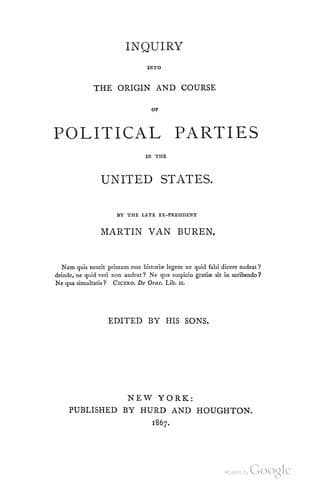
Inquiry Into the Origin and Course of Political Parties in the United StatesVan Buren, Martin
History
Inquiry Into the Origin and Course of Political Parties in the United States
Van Buren, Martin
Political parties -- United States
The course pursued by the State department was by his express direction,
and of course upon his responsibility. This he always avowed, and this
would have appeared in the report of the case of Marbury and Madison, if
the fact had not been designedly and for obvious reasons suppressed. It
was to accomplish this object that the statement of the case which
accompanies the elaborate opinion of Chief Justice Marshall was made to
present an appearance so ambiguous and unlawyer-like. Mr. Madison, it is
stated, refused to deliver the commission. On what grounds? That is not
stated, only that his explanations were not satisfactory to the relator.
If they had been given the fact referred to would have appeared on the
face of the record, and would have gone down to posterity as an answer
to the reasoning of the opinion. The refusal of the witnesses--clerks in
the department--to be sworn or to answer, and the decision of the court
that they should be sworn and answer under certain restrictions, and
that they were sworn, are all stated with much particularity, but what
they said is not stated. Here, again, the fact is suppressed that the
commission was retained in the executive department by the orders of the
President, who, in the exercise of executive discretion, regarded it as
the evidence of an appointment not completed, and which he decided not
to complete.
But this was only a foretaste of the spirit with which the scheme of the
Federal party to raise the judicial department of the Federal
Government, not only over the States and their judicatories but over the
two other departments of the General Government, was to be met. Two
months had not elapsed after the delivery of the opinion of the Chief
Justice in Marbury _v._ Madison, before the entire judicial fabric which
that party had erected during the last moments of their expiring power,
by which twenty-one additional federal judges were appointed, eighteen
in the States and three in the District of Columbia, with large salaries
and still larger power, to hold their offices virtually for life, was
overthrown by the vote of a majority of Congress, a majority more
confiding, more harmonious, and better disposed to second and sustain
the measures of the executive than any we have ever had.
Public-domain text, read in full here on John Shaqi.
Reviews
Reviews
No reviews yet
Be the first to share your thoughts on this work.
Elsewhere in the archive
Join the Discussion
Join the discussion
Sign in to leave a comment or review.
Sign InorCreate an account