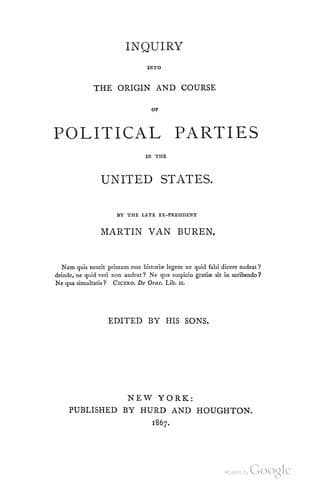
Inquiry Into the Origin and Course of Political Parties in the United StatesVan Buren, Martin
History
Inquiry Into the Origin and Course of Political Parties in the United States
Van Buren, Martin
Political parties -- United States
This measure--the least important effect of which was to relieve the
national treasury from the payment of salaries to some twenty-seven or
thirty gentlemen, whose services an experience of more than half a
century has shown to have been unnecessary--was assailed with
unprecedented violence. Gouverneur Morris said it had stricken down the
sanctity of the judiciary, and his political associates in Congress
denounced it as a gross infraction of the Constitution. He spoke of it
with the same vehemence and heat with which he taunted the men who had
passed it and their successors, twelve years afterwards, at the federal
celebration of the restoration of the Bourbons, when he invited them, by
the appellation of the "savage and wild democracy," to see, "though it
should blast their eye-balls, royal princes surrounded by loyal
subjects!" The attempts of Mr. Morris and his coadjutors to exasperate
the public mind against the repeal of the midnight Judiciary Act
recoiled upon their party. The only effects they produced were to rivet
the convictions of a large majority of the people that they had acted
wisely in changing their rulers, and to evoke a determination to sustain
the men in power as long as they adhered to the course upon which they
had entered. To the Chief Justice, his associates on the bench, and the
leaders of the defeated party, this condition of public opinion
presented considerations of the gravest import. The court had decided,
and their decision was sustained by the latter with perfect unanimity,
that the appointment of Marbury had been completed before Mr. Jefferson
came into office, that the Secretary of State had therefore no right to
withhold his commission, and that he could be compelled to deliver it by
_mandamus_, provided only that the proceedings should originate in an
inferior court. There was no ground for question in respect to the
legality of the appointments of the midnight judges, or their clerks, if
the repealing law was unconstitutional, nor of their right to their
salaries. This was certainly a question for the judiciary in respect to
private rights; and if the courts could compel the one Secretary by
_mandamus_ to deliver a commission wrongfully withheld, _a fortiori_
could they compel another to pay salaries undeniably due if the
repealing law was unconstitutional. The field for the writ of _mandamus_
was thus greatly enlarged. If the withholding of a few justices'
commissions constituted good ground for the institution of such
proceedings as those we have referred to, the case now presented was one
of much greater magnitude, and no party was ever more deeply committed
before the country on a public question than they were in regard to the
unconstitutionality of the Repealing Act. If they were right in that,
and also in their views in respect to the powers of the Supreme Court, a
_mandamus_ would of course have been authorized to compel the treasury
to pay the judges their salaries.
Public-domain text, read in full here on John Shaqi.
Reviews
Reviews
No reviews yet
Be the first to share your thoughts on this work.
Elsewhere in the archive
Join the Discussion
Join the discussion
Sign in to leave a comment or review.
Sign InorCreate an account