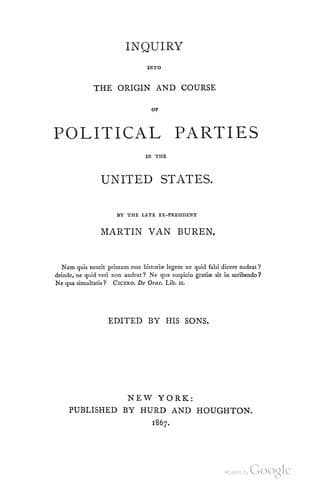
Inquiry Into the Origin and Course of Political Parties in the United StatesVan Buren, Martin
History
Inquiry Into the Origin and Course of Political Parties in the United States
Van Buren, Martin
Political parties -- United States
it such if it so believed.
Chief Justice Marshall remained at the head of the Supreme Court many
years after the delivery of his opinion in the case of Marbury and
Madison. During that long period he not only acquired, by the exercise
of his great talent, the high distinction of which I have already
spoken, but endeared himself by his personal demeanor to all who were
drawn within the circle of his acquaintance. No generous mind could
contemplate a man possessed of such towering intellect, placed in so
elevated a position and bearing his honors with such modesty and
unaffected simplicity as he habitually displayed, without being
impressed with a deep interest in his character. I was not among the
least cordial of his admirers, and would not for the world speak a
wanton or unkind word in disparagement of his memory. But the public
acts of public men are always and under all circumstances legitimate
materials for history, and may be canvassed with freedom, provided they
are spoken of truly, and reviewed "with good motives and for justifiable
ends." To this limitation it shall be my endeavor to confine myself on
this as on all other occasions.
No part of the fame which Chief Justice Marshall acquired on the bench
was due to his course and conduct in the case of Marbury and Madison,
which may with truth be regarded as his judicial _début_. He had been
snatched from the political caldron, heated to redness by human
passions, almost at the moment of his first appearance on the bench. In
his rapid transition from the halls of Congress and the Departments of
War and State to that of the Judiciary, he had, as it were, been driven
to the bench as to a place of safety before a tempest of public
indignation created by the abuses of the administration of which he had
been a part. Among his first acts after reaching it, and before time had
been allowed for his passions to cool, before he had acquired judicial
habits or had leisure to think even of the amenities that should
distinguish his new position, was a severe blow at the wizard who, he
believed, had raised the wind and directed the storm. But Jefferson, the
"dreaming Condorcet," as Hamilton sometimes called him, proved an
accomplished statesman. Wide awake, he made ample preparations for the
assault, interposed effectual resistance, and the recoil and ultimate
abandonment were the result. I have heretofore referred to the
non-observance in these proceedings of due respect toward the acts of a
coördinate department of the Government,--an obligation on the part of
each from which no consideration can release them, and which in this
case was rendered still more imperative by the relations, personal and
political, that had existed between the President and the Chief Justice.
Whatever weaknesses I may be subject to,--and doubtless they are
numerous,--dogmatism, I am very sure, is not one of them. My endeavor
always is to state my positions with deference to the judgments of
others.
Public-domain text, read in full here on John Shaqi.
Reviews
Reviews
No reviews yet
Be the first to share your thoughts on this work.
Elsewhere in the archive
Join the Discussion
Join the discussion
Sign in to leave a comment or review.
Sign InorCreate an account