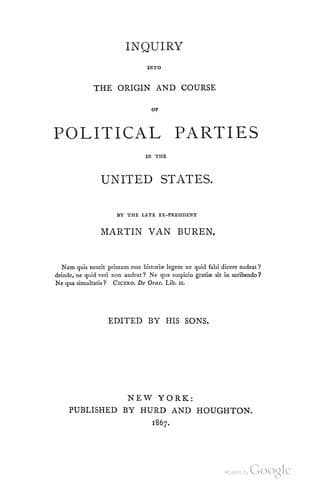
Inquiry Into the Origin and Course of Political Parties in the United StatesVan Buren, Martin
History
Inquiry Into the Origin and Course of Political Parties in the United States
Van Buren, Martin
Political parties -- United States
Should they resume the Marbury and
Madison case in the inferior courts, and proceed in this also, or should
they abandon both and submit themselves to the stigma of having been the
authors of false pretences and unfounded clamor, was the question to be
met.
The Republican party of the Union, as then constituted, was for the
first time in possession of two departments of the Federal Government.
Whilst in a minority they had not been regarded by their high-reaching
opponents with feelings of much respect. Whatever might still have been
the federal impressions of their principles or designs, there was no
longer room for two opinions, in respect to their determination, their
firmness and their capacity to carry out the measures they deemed
necessary to the public service. Such being the circumstances in which
they were placed, the Chief Justice, his associates and friends,
surveyed the exposures and defenses of the only department that was left
under their control, and it was natural that they should ponder upon
possible consequences before they proceeded another step in a course
which the other departments regarded as one of aggression.
The supervision and control of the Supreme Court of the United States
over the largest portion of the legislation and jurisprudence of the
State governments, designed to be secured by the twenty-fifth section of
the Federal Judiciary Act and the extent to which they might be carried,
were, in their political aspects, looked upon by Hamilton and his
followers as constituting the only remaining sheet-anchor of the
government, in the sense in which they desired to see it administered.
This lay completely at the mercy of their opponents. No matter what
might be their confidence in the constitutionality of the provision, the
whole appellate jurisdiction of the Supreme Court is, by the express
letter of the Constitution, to be exercised subject to "such exceptions
and such regulations as the Congress shall make." An act of three lines
repealing the clause of the Judiciary Act would except writs of error to
State courts from the appellate jurisdiction of the Supreme Court, and
another might abolish the use of the writ of _mandamus_. The members of
that court had seen too much of the temper and firmness of the President
and Congress to doubt the immediate adoption of such measures if the
contest in regard to the boundaries of power between the departments
was continued, and were too sensible of the extent to which that high
tribunal was indebted for its power and dignity to that branch of their
jurisdiction to push so unprofitable a collision one step farther under
their present auspices. The consequence was a suspension of all
movements in that direction. No more was heard of Mr. Marbury's claims
to his commission, and the new judges quietly submitted to expulsions
from their life-estates in offices by a law they claimed to be
unconstitutional, with a court within their reach authorized to declare
Public-domain text, read in full here on John Shaqi.
Reviews
Reviews
No reviews yet
Be the first to share your thoughts on this work.
Elsewhere in the archive
Join the Discussion
Join the discussion
Sign in to leave a comment or review.
Sign InorCreate an account