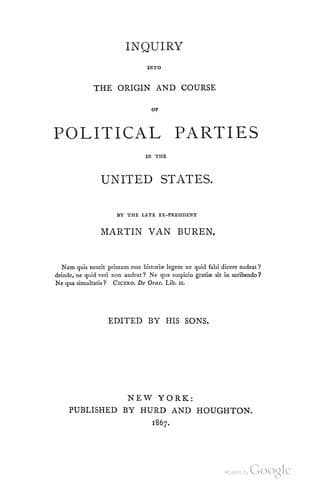
Inquiry Into the Origin and Course of Political Parties in the United StatesVan Buren, Martin
History
Inquiry Into the Origin and Course of Political Parties in the United States
Van Buren, Martin
Political parties -- United States
us, to hear me attribute his refusal to an apprehension that he might,
in the discharge of his official duties be reduced to the necessity of
acting against the principles of '98, or against his, the General's
wishes--an alternative that he preferred not to encounter. I am free to
confess that before I came to understand General Jackson as well as I
subsequently did I had not a little of the same feeling. I had seen
enough of him in the Senate, whilst occupying different sides in mere
party politics, to satisfy me that he was incapable of acting knowingly
against the public interest, but it was some time before I became
thoroughly satisfied that I did not do full justice to his prudence. I
will allude to a single occurrence bearing upon this point. His
successful effort to remove the Indians to their Western home is well
known and ought never to be forgotten, for there has scarcely been a
single act of his life which has proved more beneficial to all parties
than that. When the act conferring upon him the necessary powers was
before Congress, which was at an early period of his administration, it
was found difficult to prevail on the Pennsylvanian members of the House
to support it. They were believed to be influenced by an apprehension
that by supporting it they would give offense to the Quakers who, as is
known, are very numerous in their State. He invited them to an interview
which he asked me to attend. He remonstrated with those who came in an
earnest and really eloquent manner; placed before them very forcibly the
importance of the movement as well to the Indians as to the country;
refuted the reasons which were given for their doubts, and as they rose
to leave him, under indications not favorable to his wishes, he told
them, with much emphasis, that he could not believe that the reasons
they had assigned were the true motives by which they were actuated;
that they were men of too much sense not to see that the measure was a
proper one, but that they were afraid of their popularity; that they
stood more in dread of displeasing the Quakers than they did of doing
wrong; conjured them to rise superior to such motives, and to do what
was right, regardless of personal consequences; told them they would
find that to be the best way to make themselves popular, and concluded
by saying that he should do his duty in this respect, and if the bill
failed for the want of their vote it would not be his fault if their
constituents were not supplied with means for forming a correct judgment
between them and him. This was the substance of what was said, and said
with considerable animation, I observed his eye directed toward me
whilst he was speaking, and the moment the door closed on the retiring
delegation he turned to me with a smile upon his countenance and said
with the blandest manner, "I saw that my remarks disturbed you." I
admitted the fact, and said that although they were his friends,
Public-domain text, read in full here on John Shaqi.
Reviews
Reviews
No reviews yet
Be the first to share your thoughts on this work.
Elsewhere in the archive
Join the Discussion
Join the discussion
Sign in to leave a comment or review.
Sign InorCreate an account