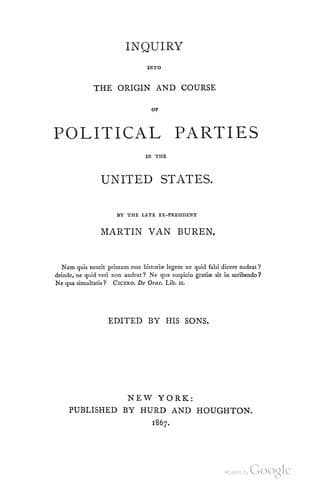
Inquiry Into the Origin and Course of Political Parties in the United StatesVan Buren, Martin
History
Inquiry Into the Origin and Course of Political Parties in the United States
Van Buren, Martin
Political parties -- United States
personal as well as political, I was apprehensive that his observations,
if they were made public, however true and just, might in the then
feverish state of the public mind give countenance to the
representations of his enemies. His reply was: "No, my friend, I have
great respect for your judgment, but you do not understand these
gentlemen as well as I do. They are quite honest, and wish to do what is
right, but are prevented from doing it by precisely the considerations
to which I alluded. They will not be offended, because they know I am
their friend, and act only for the public good, and you will see that
they will show a different disposition upon the subject"--and they did
so. My apprehensions were more on account of what I feared he might say,
from the excited manner in which he spoke, than on account of what he
did actually say; and this was but one of numerous instances in which I
observed a similar contradiction between his apparent undue excitement
and his real coolness and self-possession in which, I may say with
truth, he was seldom if ever wanting. It was to the class of Jackson's
supporters which I have described, men of Mr. Daniel's school, that
Webster made his most powerful appeal; to alarm and influence them his
powers were exerted to their utmost point. To do this with any chance of
success a perversion of the Veto Message was indispensable. We have seen
that he was obliged to admit that the President had a right, under the
Constitution, to do all that he proposed by the veto. He had sworn to
protect the Constitution as the chief executive officer of the
government; and when an act was offered for his approval which he
honestly believed was contrary to that instrument, he had the right--not
the power only but the right also--to withhold his assent. This Mr.
Webster admitted in so many words, and President Jackson did not by the
message propose to do any thing more. And yet Webster denounced him as a
ruthless tyrant, who was violating the Constitution, and uprooting the
foundations of society. Look at some of his fierce denunciations: "He
asserts a right of individual judgment on constitutional questions,
which is totally inconsistent with any proper administration of the
Government, or any regular execution of the laws. Social disorder,
entire uncertainty in regard to individual rights and individual duties,
the cessation of legal authority, confusion, the dissolution of free
government,--all these are inevitable consequences of the principles
adopted by the message, whenever they shall be carried to their full
extent.... That which is now claimed for the President is, in truth,
nothing less, and nothing else than the old dispensing power asserted by
the Kings of England in the worst of times--the very climax, indeed, of
all the preposterous pretensions of the Tudor and the Stuart races.
Public-domain text, read in full here on John Shaqi.
Reviews
Reviews
No reviews yet
Be the first to share your thoughts on this work.
Elsewhere in the archive
Join the Discussion
Join the discussion
Sign in to leave a comment or review.
Sign InorCreate an account