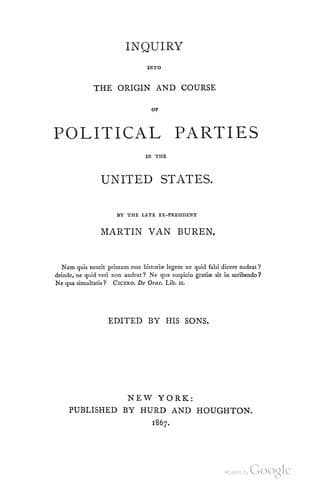
Inquiry Into the Origin and Course of Political Parties in the United StatesVan Buren, Martin
History
Inquiry Into the Origin and Course of Political Parties in the United States
Van Buren, Martin
Political parties -- United States
Judge White, then his personal and political friend, followed Mr.
Webster in the debate on the Veto Message and in the course of his
speech laid down, in a perspicuous and satisfactory manner, the
principles applicable to the question of the relative powers and duties
of the several departments of the General Government which President
Jackson then, as he had at all times, sustained. Deeply incensed at the
gross perversions of his message, on the part of the advocates of the
bank, but at all times and under all circumstances against parleying
with his enemies in the midst of a battle, the President contented
himself with frequent and unreserved expression of concurrence in the
views which had been taken of the subject, on the floor of the Senate,
by Judge White, and although reëlected under the clamor which had been
raised against him upon that point, and more determined than ever to
prevent, by all constitutional means, the extension of the charter of
the existing bank, he was equally decided, as he had always been, not to
interpose, nor did he interpose, any obstructions to the employment by
it of all the means provided by the charter to conduct business to its
end and to wind up its affairs after its termination.
Senator White's definition of the Constitution was expressed in the
following words: "The honorable Senator argues that the Constitution has
constituted the Supreme Court a tribunal to decide great constitutional
questions, such as this; and that when they have done so, the question
is put at rest, and every other department of the government must
acquiesce. This doctrine I deny. The Constitution vests 'the judicial
power in a Supreme Court, and in such inferior courts as Congress may
from time to time ordain and establish.' Whenever a suit is commenced
and prosecuted in the courts of the United States, of which they have
jurisdiction, and such suit is decided by the Supreme Court,--as that is
the court of last resort,--its decision is final and conclusive between
the parties. But as an authority it does not bind either the Congress or
the President of the United States. If either of these coördinate
departments is afterwards called upon to perform an official act, and
conscientiously believes the performance of that act will be a violation
of the Constitution, they are not bound to perform it, but, on the
contrary, are as much at liberty to decline acting as if no such
decision had been made.... If different interpretations are put upon the
Constitution by the different departments, the people is the tribunal to
settle the dispute. Each of the departments is the agent of the people,
doing their business according to the powers conferred; and where there
is a disagreement as to the extent of these powers, the people
themselves, through the ballot-boxes, must settle it."
Public-domain text, read in full here on John Shaqi.
Reviews
Reviews
No reviews yet
Be the first to share your thoughts on this work.
Elsewhere in the archive
Join the Discussion
Join the discussion
Sign in to leave a comment or review.
Sign InorCreate an account