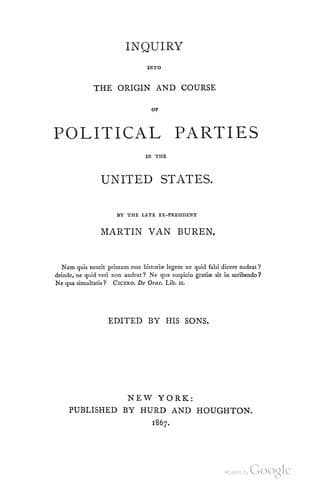
Inquiry Into the Origin and Course of Political Parties in the United StatesVan Buren, Martin
History
Inquiry Into the Origin and Course of Political Parties in the United States
Van Buren, Martin
Political parties -- United States
This is the true view of the Constitution. It is that which was taken by
those who framed and adopted it, and by the founders of the Democratic
party. It is one which was universally acquiesced in at the formation of
the Government, and for some time thereafter. It is a matter of great
moment, and one which cannot be too closely scrutinized, especially at
the present moment when there is abundant reason to apprehend that
heresies of a marked character in respect to it are being infused into
the public mind. The principle which inculcates the necessity of
distributing the powers of government among several departments, and
that they should be independent of each other in the performance of the
duties assigned to them by the Constitution, has united in its favor the
opinions of the friends of liberty everywhere from a very early period
to the present time. Montesquieu said: "There can be no liberty where
the legislative and executive powers are united in the same person or
body of magistrates;" or "if the power of judging be not separated from
the legislative and executive powers." The American Revolution provided
the fairest opportunity to test the merits of this doctrine that the
world had ever seen, and it was not lost sight of by the statesmen of
that day. Many of the States recorded their adherence to it on the face
of their constitutions, some of which were framed and adopted _flagrante
bello_, and all paid due respect to it in the construction of their
organic laws. The settlement and ratification of the Federal
Constitution carried the discussion of its merit to our national
councils where, and more particularly in the discussion upon the
question of ratification, the matter was very closely examined and by
very able hands. The opponents of the Constitution resisted it earnestly
and with ability, on the ground, amongst others, that it did not provide
sufficient guarantees to protect the departments from reciprocal
encroachments, and to secure the required independence of each. The
difficulties, inherent in the very nature of government, of carrying
those securities to an extent which would silence cavil in respect to
them, obtained for this objection advantages which, in view of the well
understood reverence of the people for the main principle, caused no
small degree of inquietude to those able defenders of the
Constitution--Madison, Hamilton, and Jay. The numbers of the
"Federalist" which touch upon this point are full of interest and will
well repay re-perusal. They afford the strongest evidence of an earnest
adherence, on the part of those great men, to the general principle, and
will, if I do not deceive myself, be found quite inconsistent with
several positions which have since been taken upon the subject. In the
47th number of the "Federalist," Mr. Madison thus expresses his own
views, and of course those of his associates, Hamilton and Jay, as they
acted in concert: "One of the principal objections inculcated by the
Public-domain text, read in full here on John Shaqi.
Reviews
Reviews
No reviews yet
Be the first to share your thoughts on this work.
Elsewhere in the archive
Join the Discussion
Join the discussion
Sign in to leave a comment or review.
Sign InorCreate an account