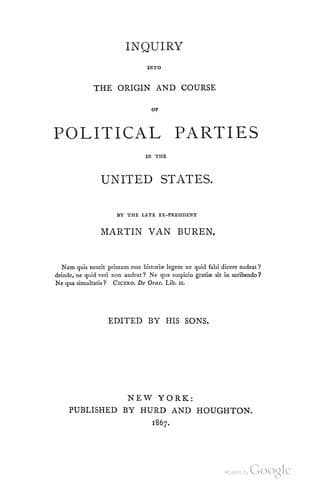
Inquiry Into the Origin and Course of Political Parties in the United StatesVan Buren, Martin
History
Inquiry Into the Origin and Course of Political Parties in the United States
Van Buren, Martin
Political parties -- United States
The provisions of the Constitution will be searched in vain for any
which indicate a design on the part of its framers to give to one of the
departments power to control the action of another in respect to its
departmental duties under that instrument. All _legislative power_
granted by the Constitution was vested in a Congress, to be composed of
two Houses. The _executive power_ of the Government was vested in a
President. Specific powers to be exercised in conjunction with the
Senate, as well as some in respect to which a question might arise
whether they would otherwise have passed to the executive, were added,
but the Constitution in respect to the legislative power, contained no
limitations or restrictions. All executive authority to be exercised
under it was granted to the President, and he was hence spoken of by the
writers of the "Federalist" as the _sole depositary_ of executive power.
By the third article of the Constitution the same expression is used in
respect to the Supreme Court, &c.: "_The judicial power of_ the United
States shall be vested in _one Supreme Court_ and certain inferior
tribunals." But as these terms would, standing by themselves, have
conveyed all the judicial power of the United States to the Supreme
Court, and as no such grant could be properly made because a large share
of it had, in a previous part of the Constitution, been granted to a
court of impeachment, of which the Supreme Court only supplied the
presiding officer on a single occasion,--the trial of a President,--and
was designed to be still farther restricted, the Constitution
immediately proceeds to say, that "The judicial power shall extend to
all cases in law and equity arising under this Constitution, the laws of
the United States, and treaties made, or which shall be made, under
their authority; to all cases affecting, ambassadors, other public
ministers, and consuls; to all cases of admiralty and maritime
jurisdiction, etc." No oath to support the Constitution is prescribed by
it, in regard to the incumbents of the legislative or judicial branches
of the Government, other than the general provision that all officers of
a certain description, (which included them,) whether belonging to the
Federal or State governments, should swear to support the Federal
Constitution.
In regard to the executive department the case is very different. The
Constitution requires from the President, and from him only, that he
should, in addition to the oath of office, before he enter upon its
duties, swear "_that he will, to the best of his ability, preserve,
protect, and defend the Constitution of the United States_."
Public-domain text, read in full here on John Shaqi.
Reviews
Reviews
No reviews yet
Be the first to share your thoughts on this work.
Elsewhere in the archive
Join the Discussion
Join the discussion
Sign in to leave a comment or review.
Sign InorCreate an account