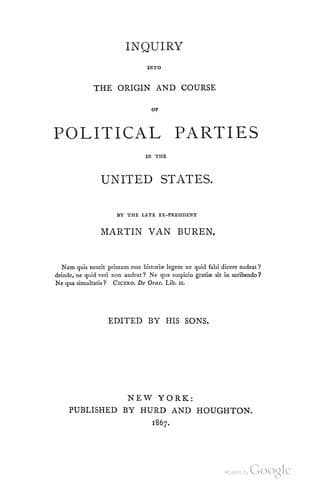
Inquiry Into the Origin and Course of Political Parties in the United StatesVan Buren, Martin
History
Inquiry Into the Origin and Course of Political Parties in the United States
Van Buren, Martin
Political parties -- United States
more respectable adversaries to the Constitution, is its supposed
violation of the political maxim that the legislative, executive and
judiciary departments ought to be separate and distinct. In the
structure of the Federal Government no regard, it is said, seems to have
been paid to this essential precaution in favor of liberty. The several
departments of power are distributed and blended in such a manner as at
once to destroy all symmetry and beauty of form, and to expose some of
the essential parts of the edifice to the danger of being crushed by the
disproportionate weight of other parts.
"No political truth is certainly of greater intrinsic value, or is
stamped with the authority of more enlightened patrons of liberty, than
that on which the objection is founded. The accumulation of all powers,
legislative, executive, and judiciary in the same hands, whether of one,
a few, or many, and whether hereditary, self-appointed, or elective, may
justly be pronounced the very definition of tyranny. Were the Federal
Constitution, therefore, really chargeable with this accumulation of
power, or with a mixture of powers having a dangerous tendency to such
an accumulation, no further arguments would be necessary to inspire a
universal reprobation of the system".... In No. 48, speaking of the
three great departments, he says: "It is equally evident that neither of
them ought to possess, directly or indirectly, an overruling influence
over the others in the administration of their respective powers." ...
In No. 49, he notices a proposition of Mr. Jefferson to authorize a
Convention upon a call of two of the three departments, for "altering
the Constitution or correcting breaches of it," and says,--"The several
departments being perfectly coördinate by the terms of their common
commission, neither of them, it is evident, can pretend to an exclusive
or superior right of settling the boundaries between their respective
powers." He then goes on to urge objections to too frequent appeals to
the people in that form, and sustains the opinion that it would be
better to rely on other safeguards against encroachments which he
details. In Nos. 78 and 81, General Hamilton, admitting that "there is
no liberty where the power of judging be not separated from the
legislative and executive powers," shows at great length the comparative
weakness of the judicial power, and the very slight probability that
"the general liberty of the people can ever be endangered from that
quarter."
Public-domain text, read in full here on John Shaqi.
Reviews
Reviews
No reviews yet
Be the first to share your thoughts on this work.
Elsewhere in the archive
Join the Discussion
Join the discussion
Sign in to leave a comment or review.
Sign InorCreate an account