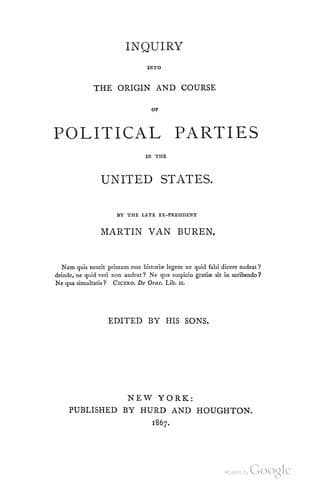
Inquiry Into the Origin and Course of Political Parties in the United StatesVan Buren, Martin
History
Inquiry Into the Origin and Course of Political Parties in the United States
Van Buren, Martin
Political parties -- United States
The judicial power of the Federal Government, according to the
description here given of the binding force, the finality and efficiency
of its decisions upon the parties and their rights in all cases which
may be brought before it, answers all the purposes of its institution.
Was it the intention of the framers of the Constitution that it should
be clothed with other powers, and if so, what are they? The duties
imposed on the executive and legislative departments are of higher
importance than those of the judiciary, in proportion as the interests
of the nation are of more consequence than the separate interests of
individuals and minor associations. They include the question of peace
or of war, and the maintenance of the latter, international obligations
in the forms of treaties, their construction and execution, the
regulation of foreign commerce and commerce among the States, the
regulation of the currency, the establishment of a mint, the assessment
and collection of the national revenue, the raising, regulating, and
command of an army and navy, the establishment of a general and of
particular post-offices, the regulation and protection of the Indian
tribes, and many other duties which it is unnecessary to specify. In
none of these is it contemplated by the Constitution that the judicial
power shall take a part. The powers and duties of the other departments
upon these subjects are to some extent specified in the Constitution,
and the residue are left to the direction of the legislature which acts,
in respect to them, through the Executive as the department especially
charged with the execution of the laws. In the performance of their high
duties these departments are, at almost every step, met by
constitutional questions. The Houses of the legislature, in every law or
resolution that they pass, have to consider whether it is authorized by
the Constitution to which they have sworn to conform, and the President
and Senate, when they make a treaty, are bound to consider and decide
the same question. The President, as the sole depositary of the
executive power, is under a similar obligation. His first inquiry is,
whether the Constitution authorizes him to apply the power of his
department to the execution of the business before him, or, if it is one
of the numerous functions which the legislature is in the constant
habit of calling upon him to perform, has the legislature power under
the Constitution to direct the thing to be done, and can he do it
consistently with his oath to preserve and uphold that instrument?
Public-domain text, read in full here on John Shaqi.
Reviews
Reviews
No reviews yet
Be the first to share your thoughts on this work.
Elsewhere in the archive
Join the Discussion
Join the discussion
Sign in to leave a comment or review.
Sign InorCreate an account