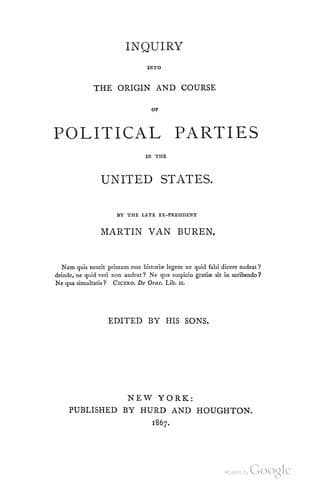
Inquiry Into the Origin and Course of Political Parties in the United StatesVan Buren, Martin
History
Inquiry Into the Origin and Course of Political Parties in the United States
Van Buren, Martin
Political parties -- United States
How are they to act in the decision of these questions? By what
considerations are they to be controlled? They know that they are
responsible to the people, under whose commission they act, for all they
do. The Constitution does not give to one department the right to decide
such questions for another, either in terms or by necessary implication,
nor subject them to any other responsibility, nor place before them any
guide for the government of their decisions other than their own
discretion and their own consciences, and has caused to be placed upon
their consciences an oath that they will, in no event, act contrary to
that instrument. Under such circumstances, I ask, what are they to do?
What can they do, consistently with the duty they owe to God, to their
country, and to themselves, other than to decide such questions for
themselves, following the dictates of their own judgment? Can it be
believed that those who framed and adopted the Constitution intended to
place these high functionaries,--the only representatives of the people,
in the great departments of the government, over whose continuance in
office the people possess control--to place them, in respect to their
official acts, about which a constitutional question can be raised,
under the guidance of a department over which the people possess no such
control, to be regulated by its decisions in private actions, to which
such functionaries are not parties, and of which decisions they are,
notwithstanding, to take notice at their peril. If a system so
anti-republican could have been designed by those who made the
Constitution, is it to be supposed that they would have omitted to
declare, on the face of the instrument, that such was their intention,
leaving those functionaries to grope their way to its discovery. Such a
question--one in which the character of our political institutions is so
much involved, and upon a right understanding of which their ultimate
safety may depend--should be stripped of every uncertainty. The claim
set up for the Supreme Court must be good throughout, or it is not good
at all. The principle, that the final decision of constitutional
questions belongs exclusively to the supreme judicial tribunal, set up
in Mr. Webster's speech, must be true throughout, or it cannot be true
to any extent. It amounts to this: the incumbents of the legislative and
executive departments, in respect to questions of constitutional power,
are _ministerial officers only_. Constitutional questions are points in
respect to which they have no right to exercise their own discretion,
but are bound, at every important step, to look to the judiciary for
guidance, and if they omit to adopt its decisions, if it has made any,
they do so at their peril:--the former department at the hazard of
having its laws, if the Supreme Court regard them as unconstitutional,
treated as a nullity, not only when they are relied upon "in cases in
law and equity," but in all cases, and everywhere.
Public-domain text, read in full here on John Shaqi.
Reviews
Reviews
No reviews yet
Be the first to share your thoughts on this work.
Elsewhere in the archive
Join the Discussion
Join the discussion
Sign in to leave a comment or review.
Sign InorCreate an account