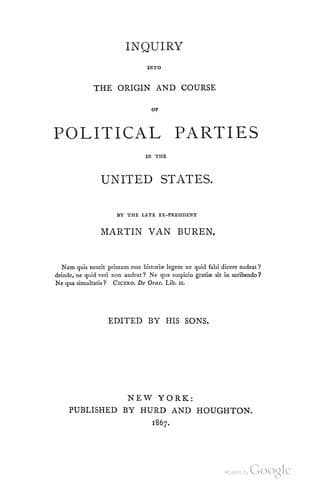
Inquiry Into the Origin and Course of Political Parties in the United StatesVan Buren, Martin
History
Inquiry Into the Origin and Course of Political Parties in the United States
Van Buren, Martin
Political parties -- United States
But loving mankind in my individual relations
with them, I pray to be permitted to depart in their peace, and, like
the superannuated soldier, '_quadragenis stipendiis emeritis_,' to hang
my arms on the post."
Mr. Jefferson, in these letters, speaks of his uniform opposition to the
opposite doctrine, and refers to the inconvenience that may at times
arise from conflicting decisions. But that, he thought, might be safely
dealt with through the prudence of public functionaries, and he names
instances when they were so treated: one in England, where an instance
of difference occurred, in the time of Lord Holt, between the judges of
England and the House of Commons; and another in this country, when a
difference of opinion was found to exist between the Federal Judiciary
and the House of Representatives. The Supreme Court decided, in a case
of _meum and tuum_, that William Duane was not a citizen, and the
House of Representatives, upon a question of membership, decided that
William Smith, whose character of citizenship stood on precisely the
same ground, was a citizen. These decisions were made in high party
times, whilst the Federalists were in power. Duane was an Irishman, who
had married into the family of Dr. Franklin, and was editor of the
"Aurora," the most prominent Republican newspaper. Smith was an ardent
Federalist from South Carolina, a man of good talents himself, but who
delivered speeches in the House prepared by Hamilton in his closet, as
was charged by Jefferson at the time, and has now been fully proved by
the publication of Hamilton's private papers.
But the establishment of the constitutional rule sustained by Jefferson
would not have saved the country from practical inconveniences, which he
did not notice because he knew them to be unavoidable. A concession to
the other great departments of the right to decide for themselves
constitutional questions applicable to, and that necessarily arise in
the discharge of, their official functions, still leaves them, to a
serious extent, dependent upon the judicial power. Whilst it would
exempt the incumbents from the penalty of impeachment when they act in
good faith, they and their subordinates remain liable whenever their
acts may be construed into an injurious interference with the property
or personal rights of individuals, to be called before the judicial
tribunal, to be there subjected to a different interpretation of the
Constitution from that which they, or their superiors in authority, have
placed upon it, and to be melted in damages for their public acts,
however pure their motives may have been.
Public-domain text, read in full here on John Shaqi.
Reviews
Reviews
No reviews yet
Be the first to share your thoughts on this work.
Elsewhere in the archive
Join the Discussion
Join the discussion
Sign in to leave a comment or review.
Sign InorCreate an account