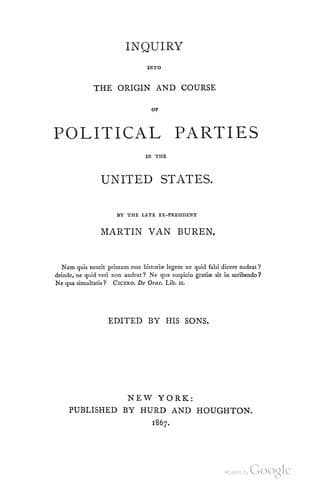
Inquiry Into the Origin and Course of Political Parties in the United StatesVan Buren, Martin
History
Inquiry Into the Origin and Course of Political Parties in the United States
Van Buren, Martin
Political parties -- United States
James Madison, in conjunction with Hamilton and Jay, in the numbers of
the "Federalist," avows doctrines at war with this assumption of power
in the Supreme Court. Thomas Jefferson, whose anxious patriotism was
always alive to such subjects, and the political thoughts and studies of
whose life were exclusively directed toward the protection of human
rights through the instrumentality of free governments, opposed the
doctrine vehemently, from first to last, and long after his retirement
from public life, its passions and excitements, expressed himself in
regard to it, on different occasions, in terms which follow. In 1815, in
answer to the direct question put to him by a citizen of Georgia, he
says:--"The second question, whether the judges are invested with
exclusive authority to decide on the constitutionality of a law, has
been heretofore a subject of consideration with me in the exercise of
official duties. Certainly there is not a word in the Constitution which
has given that power to them more than to the executive or legislative
branches. Questions of property, of character, and of crime, being
ascribed to the judges, through a definite course of legal
proceeding,--laws, involving such questions, belong, of course, to them,
and as they decide on them ultimately and without appeal, they, of
course, decide _for themselves_. The constitutional validity of the law,
or laws, again prescribing executive action, and to be administered by
that branch ultimately and without appeal, the executive must decide for
_themselves_, also, whether, under the Constitution, they are valid or
not. So, also, as to laws governing the proceedings of the legislature;
that body must judge _for itself_ the constitutionality of the law, and,
equally, without appeal or control from its coördinate branches. And, in
general, that branch which is to act ultimately, and without appeal, on
any law, is the rightful expositor of the validity of the law,
uncontrolled by the opinions of the other coördinate authorities."
Again, so late as 1819, in a very interesting letter to Judge Spencer
Roane, he says:--"My construction of the Constitution is very different
from that you quote. It is that each department is truly independent of
the others, and has an equal right to decide for itself what is the
meaning of the Constitution in the cases submitted to its action; and
especially, where it is to act ultimately and without appeal.... But you
intimate a wish that my opinion should be known on this subject. No,
dear Sir, I withdraw from all contests of opinion and resign every thing
cheerfully to the generation now in place. They are wiser than we were,
and their successors will be wiser than they, from the progressive
advance of science. Tranquillity is the _summum bonum_ of age. I wish,
therefore, to offend no man's opinion, nor to draw disquieting
animadversions on my own. While duty required it, I met opposition with
a firm and fearless step.
Public-domain text, read in full here on John Shaqi.
Reviews
Reviews
No reviews yet
Be the first to share your thoughts on this work.
Elsewhere in the archive
Join the Discussion
Join the discussion
Sign in to leave a comment or review.
Sign InorCreate an account