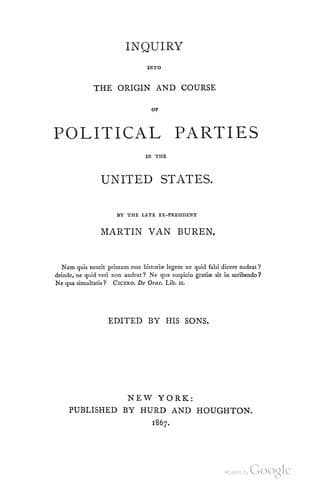
Inquiry Into the Origin and Course of Political Parties in the United StatesVan Buren, Martin
History
Inquiry Into the Origin and Course of Political Parties in the United States
Van Buren, Martin
Political parties -- United States
This union was in other respects composed of very discordant materials.
It consisted, on the one hand, of men and the descendants of men on
whose hearts the fires of persecution had burned a hatred of royalty too
deep to be erased and too zealous to be trifled with; of men who were at
the same time too conversant with human nature to allow themselves to
believe that the love of power and the proneness to its abuse were
confined to its hereditary possessors, and who were therefore anxious to
restrict grants of authority to their public functionaries to the lowest
point consistent with good government, and to subject what they did
grant to the most stringent responsibilities. They continued, also, to
cherish the same preference for their local organizations, and to
entertain the same distrust of an overshadowing central government, for
which the great body of the people had long been distinguished. They
were men whose highest ambition and desire for themselves and the
country was that it should have a plain, simple, and cheap government
for the management of the affairs of the Confederacy, republican in its
construction and democratic in its spirit,--a government that should, as
far as practicable, be deprived of the power of creating artificial
distinctions in society, and of corrupting and thus subverting the
independence of the people by the possession of a redundant patronage.
Such a government had long been the subject of their meditations, and
they braved the hazards and encountered the hardships of the
Revolutionary contest for the opportunity of establishing it.
The Revolutionary brotherhood by which the recognition of our
Independence was enforced, contained, on the other hand, men respectable
in numbers, and distinguished by talent, public service, and high social
position, who dissented from many (I may say from most) of these views,
and who regarded them as Utopian in themselves, or as too contracted for
the exigencies of the public service.
This difference in the opinions of men who had been engaged in such a
contest was all but unavoidable, and was never absent from any political
struggle of sufficient importance to be compared with it. It results,
besides those which have been indicated as peculiar to our own condition
and history, from simple but potent causes of universal operation, such
as diversities in social condition, in education, in the influence and
tendencies of previous pursuits, and in individual character and
temperament, producing diversities of views on such occasions.
Public-domain text, read in full here on John Shaqi.
Reviews
Reviews
No reviews yet
Be the first to share your thoughts on this work.
Join the Discussion
Join the discussion
Sign in to leave a comment or review.
Sign InorCreate an account