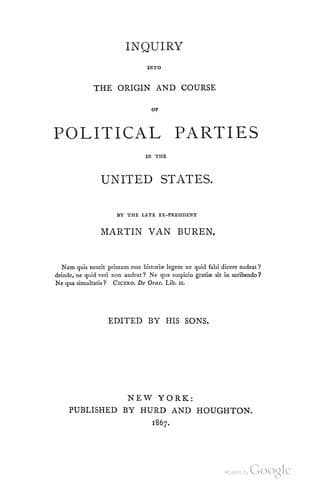
Inquiry Into the Origin and Course of Political Parties in the United StatesVan Buren, Martin
History
Inquiry Into the Origin and Course of Political Parties in the United States
Van Buren, Martin
Political parties -- United States
James Otis, Stephen Hopkins, John Adams, Gouverneur Morris, and
Alexander Hamilton, may be selected from many others as representatives
of the principles of that class to which I have referred as dissenting
from the popular or preponderating ideas of the time.
I select them the more readily from a desire to avoid mistakes, as they
were possessed of temperaments too sanguine and too fearless to be
deterred from advancing openly opinions they honestly entertained, by
their unpopularity.
There were certainly not many individuals, if there was one, who did
more to set the ball of the Revolution in motion than James Otis; and if
his career had not been cut short by the hand of violence he would have
taken high rank among the great and good men who survived the struggle.
His speech against the issuing of the Writs of Assistance had an effect
corresponding to those of Patrick Henry. Yet this highly gifted man,
whose patriotic spirit was sufficiently aroused by the oppressions of
the mother country, while yet in their incipiency, to induce him to
peril his life in acts of resistance, was an enthusiastic admirer of the
principles of the English system, and honestly believed, as he said,
"that the British Constitution came nearest the idea of perfection of
any that had been reduced to practice."
The patriotic Hopkins, one of the Rhode Island Representatives in the
General Congress, and a signer of the Declaration of Independence,
wrote--and that colony authoritatively published its concurrence in the
declaration--that "The glorious Constitution of Great Britain is the
best that ever existed among men."
Gouverneur Morris's unyielding hostility to democratic principles, and
his preference for aristocratic and monarchical institutions, were often
exhibited and unreservedly avowed, as well on the floor of the Federal
Convention as elsewhere, and have become familiar among his countrymen
as household words. There were not many, if indeed there was a single
one of his contemporaries, who went beyond him in hostility to the State
governments. "State attachments and State importance," said he in the
Federal Convention, "have been the bane of this country! We cannot
annihilate them, but we may, perhaps, take out the teeth of the
serpents." Such as were his principles at the commencement of his career
they remained to the close of his life.
Public-domain text, read in full here on John Shaqi.
Reviews
Reviews
No reviews yet
Be the first to share your thoughts on this work.
Join the Discussion
Join the discussion
Sign in to leave a comment or review.
Sign InorCreate an account