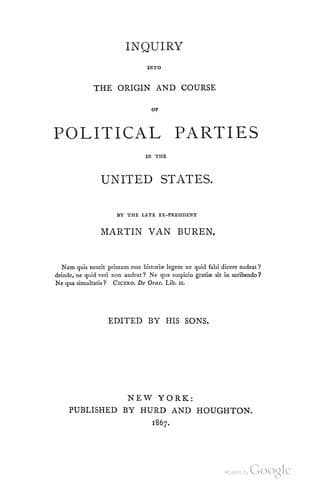
Inquiry Into the Origin and Course of Political Parties in the United StatesVan Buren, Martin
History
Inquiry Into the Origin and Course of Political Parties in the United States
Van Buren, Martin
Political parties -- United States
It is scarcely possible, at this distant day, to appreciate the terror
of irresponsible and arbitrary power which had been impressed upon the
minds of men who had themselves suffered from its excesses, or had
witnessed the cruelties it had inflicted on others, or whose fathers had
been victims of its crimes. Even Mr. Jefferson, who differed from the
Anti-Federalists in respect to these questions, as I shall hereafter
have occasion to show, though he sympathized with them in their general
feelings, in a letter to Mr. Madison in December, 1787, from Paris, upon
the subject of the Constitution, did not hesitate to say, "I own I am
not a friend to a very energetic government. It is always
oppressive."[5]
[5] 2 Jefferson's _Correspondence_, 276.
Similar feelings were exhibited by Massachusetts in 1785. That leading
State in the confederacy was, during the whole of this period, strongly
imbued with the feelings of the misnamed Anti-Federal party. This was in
no small degree owing to the talents, zeal, and activity displayed in
their behalf by Samuel Adams and John Hancock, two of the three persons
(John Adams having been the third), who were excepted by the British
Government from the offer of pardon to its rebellious subjects. Hancock
was a leading merchant and a zealous Revolutionary patriot, who had the
honor of placing his name first to the Declaration of Independence, and
the higher honor of sustaining the contest which it provoked to its
close with inflexible firmness and at unusual risks, growing out of his
large interests in commerce. Samuel Adams was equal to any man of his
day in intelligence, integrity, and patriotism. He was among the very
first who embraced the Revolution in the sense which it finally
assumed,--that of entire separation from the British Crown,--and he
supported the principles upon which it was founded, as well during the
conflict as for the residue of his long life, with great ability and
unsurpassed devotion. Whilst many of his associates, not less sincere
than himself in resistance to the despotic acts of the mother country,
could yet express their admiration of the English system and were
consequently inclined to limit their efforts to a redress of temporary
grievances, he at the earliest period avowed his hostility to kingly
government, and rallied around himself the advocates for an entire
separation, most of whom became with him early and prominent members of
the Anti-Federal party.
Public-domain text, read in full here on John Shaqi.
Reviews
Reviews
No reviews yet
Be the first to share your thoughts on this work.
Join the Discussion
Join the discussion
Sign in to leave a comment or review.
Sign InorCreate an account