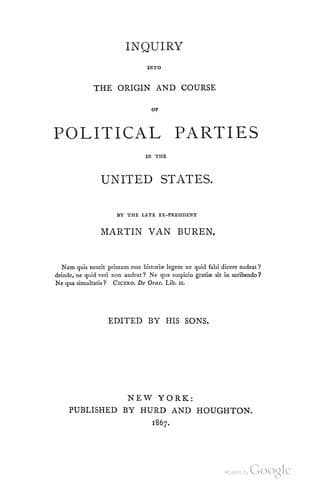
Inquiry Into the Origin and Course of Political Parties in the United StatesVan Buren, Martin
History
Inquiry Into the Origin and Course of Political Parties in the United States
Van Buren, Martin
Political parties -- United States
This letter of the delegates was laid before the legislature at their
next session, and produced a vote annulling the resolution recommending
a convention. The letter was signed by Elbridge Gerry, Samuel Holton,
and Rufus King. Mr. King, in the course of the following year, married
Miss Alsop, the only child of John Alsop, a wealthy merchant of New
York, and after having represented his native State with credit in the
Federal Convention of 1787, moved to that city; was appointed one of the
first senators in Congress from the State of New York (General Schuyler
being the other); was the friend and associate of Hamilton, Gouverneur
Morris, and Jay, and became, and continued for many years, a prominent
member of the Federal party.
Every step that was taken toward a convention was regarded with
distrust,--a distrust founded on a prevalent apprehension that the
talented and, as was believed, ambitious men who would get the control
of it, would in some way defeat those republican principles for the
right to establish which the country had made such great sacrifices.
The Commercial Convention, representing five States, which originated in
Virginia and met at Annapolis, and by which the movement that resulted
in the present Constitution was commenced, permitted Hamilton to draw up
their Address to the other States, which was also to be laid before
Congress; but insisted on giving a shape to their proposition which
would confine the Federal Convention within narrow bounds. They did this
in deference to the well understood sentiment of the country, and as the
only course, in their opinion, by which a convention could be obtained;
and accordingly they proposed "That a convention should be called to
meet at Philadelphia in May next, to devise such further provisions as
should appear to them necessary to render the Constitution of the
Federal Government adequate to the exigencies of the Union, and to
report such an act for that purpose to the United States in Congress
assembled, as _when agreed to by them, and afterwards confirmed by the
legislatures of every State_, will effectually provide for the same."[6]
[6] See _Address_; 2 Madison, 698. Not more than one, if one, of the
five States was fully in favor of a Convention.
The final action of Congress upon the subject, a majority of which
entertained similar views, consisted of a resolution, introduced by the
delegates from Massachusetts, declaring it to be the opinion of Congress
that a convention should be held at the time and place named by the
Commissioners who met at Annapolis, "for _the sole and express purpose_
of revising the Articles of Confederation, and reporting to Congress and
the several legislatures such alterations and provisions therein as
shall, _when agreed to in Congress and confirmed by the States_, render
the Federal Constitution adequate to the exigencies of government and
the preservation of the Union."[7]
[7] _Journals_ of that Congress, Vol. IV. p. 724.
Public-domain text, read in full here on John Shaqi.
Reviews
Reviews
No reviews yet
Be the first to share your thoughts on this work.
Join the Discussion
Join the discussion
Sign in to leave a comment or review.
Sign InorCreate an account