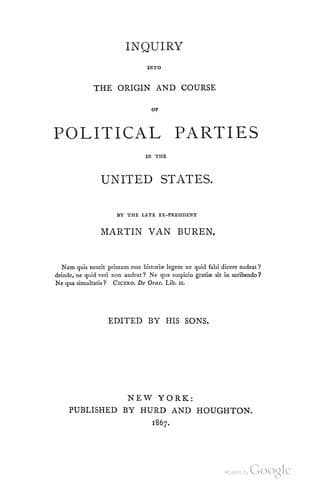
Inquiry Into the Origin and Course of Political Parties in the United StatesVan Buren, Martin
History
Inquiry Into the Origin and Course of Political Parties in the United States
Van Buren, Martin
Political parties -- United States
In a conversation between these gentlemen in 1791, to which a more
particular reference will be made hereafter, General Hamilton thus
expressed himself:--"For that mind must be really depraved which would
not prefer the equality of political rights, which is the foundation of
pure republicanism, if it can be obtained consistently with order." This
was, I do not in the least doubt, his real sentiment; but unhappily
circumstances, to which we may hereafter recur, had impressed his mind
with a conviction, which was never removed, that the great desideratum
which he mentioned--the preservation of order--could not be secured
where the control of public affairs was largely in the hands of the
people. He very correctly regarded the security of the rights of persons
and of property as an indispensable ingredient in good government; and
distrusting the respect of the people, when acting in masses, for both,
he was adverse to that equality of rights which he truly said was "the
foundation of pure republicanism." These great objects he thought could
in no other way be secured than by a strong government, in which there
would be what he called a "stable will," independent of popular control.
This he endeavored openly, and with a candor that belonged to his
character, to obtain in the Convention, and failing there, he hoped to
realize its advantages, in some degree, by strengthening what he
described as the "organs" of the Government, through the action of a
popular President and a good administration. The most important of the
measures by which he designed to accomplish these objects Mr. Jefferson
regarded as so many violations of the Constitution, and he looked upon
the spirit in which they had their origin as evidence of disaffection
to republican government, the differences in opinion between these
master spirits of the cabinet, who engrossed a share of the attention of
the people inferior only to that paid to the President, were therefore,
not limited as Washington hoped they would be, to particular measures
but presented contradictory and irreconcilable theories for the
administration of the Government, which could not even be discussed in
the cabinet without producing interminable distractions. As was to be
expected from minds like their respective systems left no middle ground,
and required the adoption of the one or the other as a rule of action
for the Government. The unavoidable obligation to make a selection
between them devolved therefore on Washington, and he discharged it, as
he did all his duties, courteously and firmly. He gave the preference to
Hamilton, and sustained him in the measures he proposed to carry out the
policy he recommended.
Public-domain text, read in full here on John Shaqi.
Reviews
Reviews
No reviews yet
Be the first to share your thoughts on this work.
Elsewhere in the archive
Join the Discussion
Join the discussion
Sign in to leave a comment or review.
Sign InorCreate an account