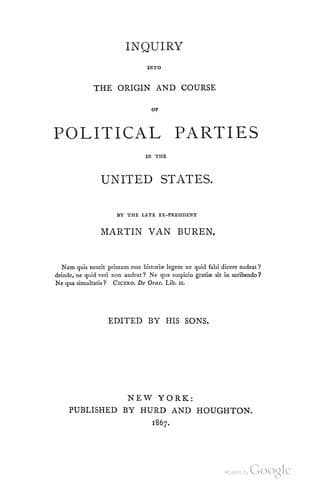
Inquiry Into the Origin and Course of Political Parties in the United StatesVan Buren, Martin
History
Inquiry Into the Origin and Course of Political Parties in the United States
Van Buren, Martin
Political parties -- United States
Mr. Jefferson, sensible that the necessity of his retirement from the
cabinet had thus become absolute, determined to take that step in a way
as little annoying to the President and as little injurious to the
public service as possible. To this end he gave early notice that he
would resign at the expiration of the President's first term of office;
and when that time arrived he retired. This left General Hamilton
without any check from his associates in the administration, save what
might proceed from the Attorney General, Edmund Randolph, who became
Secretary of State on Jefferson's retirement, and of whom the latter
said that his habit was to give his opinions to his friends and his
votes to his opponents.
Thus, next to Washington, Alexander Hamilton became the most powerful
man in the nation, abundantly able to give to party divisions their form
and pressure, and in effect to shape the action of the Government
according to his judgment by the authority with which he was invested,
and which he exerted with less restraint than had ever before or has
ever since been encountered by any minister in this country or in
Europe.
To no quarter, therefore, could our attention be more profitably
directed for instruction in the history and course of parties during his
political career than to the opinions and acts of that remarkable man.
The time has been, I am sensible, when, with vision distorted by
partisan prejudices, which seldom allow both sides of any question to be
seen, I could not have reviewed his course with the impartiality due to
truth and justice; but I am happy to believe that those feelings have
sufficiently lost their force to permit me, while dissenting more
thoroughly than ever from his principles, to do justice to his motives,
and to admit his sincerity and his desire to serve his country in the
very acts which I unreservedly condemn. The most obnoxious of his
opinions have here, thank God, become obsolete and exploded theories,
not at all dangerous as examples, and mainly referred to as historical
marks of our progress. Believing, as I think all liberal minds now do,
that they were honestly formed, we can speak of them without reproach to
their author, and censure them without being suspected of a design to
cast obloquy on his memory. The history of our partisan warfare has
presented, since his time, the anomalous feature of a persevering denial
in his name, by some of his followers, of the political opinions which
he not only did not affect to disclaim, but which he made it his
business on all fitting occasions to publish and advocate, believing
them to be right, and to the last moment of his life confidently
expecting that they would become, at no distant day, the general
sentiment of the country.
Public-domain text, read in full here on John Shaqi.
Reviews
Reviews
No reviews yet
Be the first to share your thoughts on this work.
Elsewhere in the archive
Join the Discussion
Join the discussion
Sign in to leave a comment or review.
Sign InorCreate an account