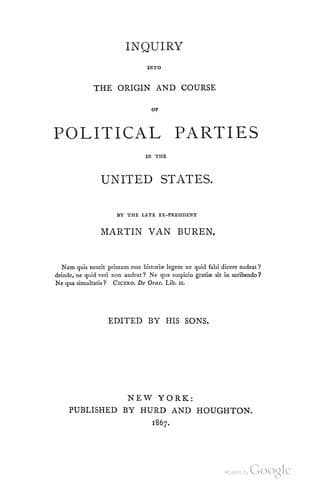
Inquiry Into the Origin and Course of Political Parties in the United StatesVan Buren, Martin
History
Inquiry Into the Origin and Course of Political Parties in the United States
Van Buren, Martin
Political parties -- United States
Mr. Charles F. Adams, in the work to which I have referred,[14] says,
"Without much hold upon the judgment or affections of the people at
large, he (Hamilton) had yet by the effect of his undisputed abilities
and his masculine will gained great sway over the minds of the
intelligent merchants along the Atlantic border. His previous doctrines,
in unison with the feelings and interests of the most conservative
class, had drawn to him their particular confidence, whilst his position
in the first administration had facilitated the establishment by him of
a chain of influence resting for its main support on _his power over the
mind of Washington himself_, but carried equally through all the
ramifications of the executive department. _Thus it happened that even
after he ceased to be personally present his opinions continued to shape
the policy of Washington's second administration, and even that of his
successor._" This declaration extending so far would have been deemed
quite credible at the period to which it relates, and, coming from the
grandson of that "_successor_"--himself the undisguised enemy of
Hamilton--was probably called forth by the recent publication of the
private papers of the latter.
[14] _Life of John Adams._ The _italics_ are my own.
As far as Mr. Adams affirms that the policy of Washington's
administration, and also, in many very important respects, that of his
successor, were guided by the opinions of Hamilton, his declaration has
my full concurrence. No candid and intelligent man can, I think, read
the evidence which has recently appeared, in connection with facts
previously known, without acknowledging the undeniable truth of these
positions. But I do not by any means intend to concede the control of
Hamilton over the mind of Washington which is implied by the terms
employed by Mr. Adams without qualifications which limit and very
materially change its character. The policy of both administrations was
guided by the opinions of Hamilton, but those opinions received their
influence through different channels, and were enforced in very
different ways. Hamilton's opinions, when known as his, had very little
weight with the successor of Washington, save, in many cases, to secure
a bad reception for themselves; but that successor had little if any
control over, or influence with, the members of his own cabinet, and not
much with Congress or the Federal party, by whom the policy of his
administration was shaped. With them Hamilton's opinions established the
rule of action. In respect to the two latter, this arose mainly from the
sway he was capable of exerting over them by the force of his great
talents, and from a general concurrence in his views. In respect to the
prominent members of Mr. Adams's cabinet his control arose from the
power he had in part acquired over their minds whilst they were also
members of General Washington's administration. Timothy Pickering, who,
after the retirement of Mr.
Public-domain text, read in full here on John Shaqi.
Reviews
Reviews
No reviews yet
Be the first to share your thoughts on this work.
Elsewhere in the archive
Join the Discussion
Join the discussion
Sign in to leave a comment or review.
Sign InorCreate an account