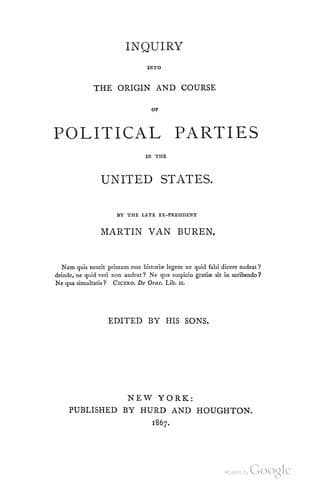
Inquiry Into the Origin and Course of Political Parties in the United StatesVan Buren, Martin
History
Inquiry Into the Origin and Course of Political Parties in the United States
Van Buren, Martin
Political parties -- United States
Jefferson and the brief term of Randolph,
was Secretary of State under both Presidents, was a remarkable man,
sincere and honest, I am willing to believe, in his political opinions,
but savagely bitter in his feelings toward his opponents. It seemed
pretty much a matter of course in him to hate those to whose political
course he was opposed, and, as is usually the case with minds thus
constituted, he was equally bigoted in his devotion to those with whom
he agreed and acted.
General Hamilton was his _beau ideal_ of a politician and statesman, and
it would not have been an easy matter in him to have dissented from any
opinion positively advanced by Hamilton, whatever his own first
impressions on the subject might have been. Mr. McHenry, Secretary of
War in both cabinets, was undoubtedly an honorable and well-disposed
gentleman. He was, in the opinion of those who had the best
opportunities for judging, including Washington and Hamilton, not
entirely competent for the duties of his office, and that circumstance
drove him the more to rely for support on Hamilton, for whom he
cherished an early and ardent friendship. His personal devotion to
Hamilton was such as to prevent Mr. Adams from longer overlooking his
incompetency, as Washington had done, and precipitated his resignation.
Oliver Wolcott, Secretary of the Treasury, the member of his cabinet
most trusted by President Adams because the least suspected, was,
notwithstanding, the one among his official advisers who went the
greatest lengths to testify his entire allegiance to Hamilton, who had
been the artificer of his political fortunes from the beginning and by
whose influence he had been advanced to the high position he occupied.
Throughout he advised with and was assisted by Hamilton in the
performance of his official duties. Such was Hamilton's "power over his
mind" that he was applied to successfully by the former for evidence of
facts to be derived from the treasury archives to sustain an attack that
Hamilton contemplated making upon the President--an attack that he did
make, although he acknowledged to Wolcott that it would not be regarded
as proper that he should have received the evidence at his hands, and
that that fact ought not therefore to be known.
No one can read the correspondence between General Hamilton and Mr.
Wolcott, as recently published with Hamilton's Works, without regretting
that the parties to it should have been so forgetful of the proprieties
due to the occasions to which it relates, or without a disposition to
excuse the strong expression of Mr. Charles F. Adams, in speaking of his
grandfather's cabinet, applied to Mr. Wolcott "as the most venomous
serpent of them all."
Public-domain text, read in full here on John Shaqi.
Reviews
Reviews
No reviews yet
Be the first to share your thoughts on this work.
Elsewhere in the archive
Join the Discussion
Join the discussion
Sign in to leave a comment or review.
Sign InorCreate an account