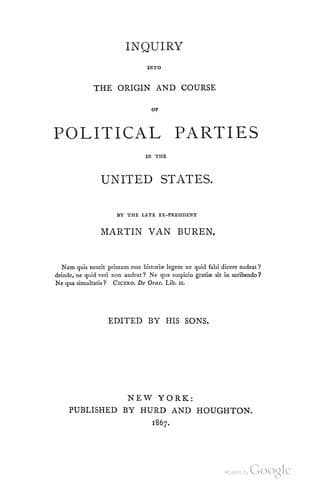
Inquiry Into the Origin and Course of Political Parties in the United StatesVan Buren, Martin
History
Inquiry Into the Origin and Course of Political Parties in the United States
Van Buren, Martin
Political parties -- United States
peremptorily and indignantly repelled. It is evident from the whole
tenor of Washington's life that no man ever lived who was more tenacious
of self-respect, or more absolute in his reservation of the right to
judge for himself of what belonged to his individual independence and
personal dignity, or more prompt to resist every attempt to encroach
upon either. No one understood his temperament in that respect better
than General Hamilton, or would have been less likely to bring himself
in conflict with it. Many indications of this understanding and of its
effects are to be found in the accounts of their personal intercourse.
The correspondence between them in regard to the discreditable use that
Washington thought was being made in Congress of the sufferings and
dissatisfaction of the army, already referred to, will be found to throw
much light upon the sense of both as to the nature of their personal
relations.
In June, 1793, Hamilton announced to President Washington, that
considerations relative both to the public interest and _his own
dignity_ had brought his mind to the conclusion to resign his office at
the termination of the close of the next session of Congress, and one of
the reasons he assigned for delaying his final retirement to that period
was to give Congress an opportunity to complete the investigation that
had been instituted in regard to his official conduct. In March
thereafter Hamilton informed the President that the committee charged to
inquire, among other things, "into the authority of the President
respecting the making and disbursement of the loans under certain acts
of Congress," were about to meet. He sent to him at the same time, a
copy of a paper he had presented to the committee, containing his
opinion in relation to the proper limits of a legislative inquiry, but
said that he deemed it expedient to fix in advance, with the President,
on the true state of facts, of which he proceeded to make a statement,
and requested the President to sanction it. General Washington soon
thereafter made a declaration, in the form of a letter to Hamilton, of
his recollections and opinions in respect to the matter. The latter, in
reply, protested vehemently against the sufficiency of the declaration
for the protection of his honor, and in a letter of considerable length,
written with his usual ability, undertook to show that the character of
the President's declaration would enable, his (Hamilton's) enemies to
say that "the reserve of the President is a proof that he does not think
that Hamilton's representations are true, else his justice would have
led him to rescue the officer concerned even from suspicion upon the
point."
Public-domain text, read in full here on John Shaqi.
Reviews
Reviews
No reviews yet
Be the first to share your thoughts on this work.
Elsewhere in the archive
Join the Discussion
Join the discussion
Sign in to leave a comment or review.
Sign InorCreate an account