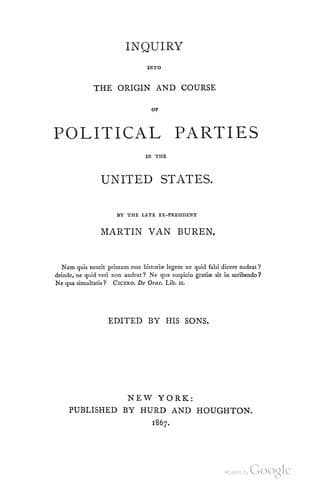
Inquiry Into the Origin and Course of Political Parties in the United StatesVan Buren, Martin
History
Inquiry Into the Origin and Course of Political Parties in the United States
Van Buren, Martin
Political parties -- United States
Mr. Charles F. Adams places Hamilton's sway over the mind of Washington
upon the same footing with that which he exerted over the executive
department, composed principally of the members of his second cabinet of
whom we have been speaking. From this view I entirely dissent. If
Hamilton possessed any power over the mind of Washington, it was of a
very different character from that which he exercised over those
members. Washington was to an unusual extent free from the weakness of
overrating his own powers; with just conceptions of his capacities for
public service he was always ready to place them at the public disposal,
but he was very far from pretending to qualifications which he did not
possess. No one was more sensible than he that the science of civil
government--the construction of constitutions and the administration of
the civil affairs of the State--were not best learned in the camp, where
so large a portion of his life had been spent. He therefore, as we have
seen, selected two of the ablest statesmen in the country, particularly
versed in those portions of the public business which he devolved upon
them. They differed irreconcilably in respect to the policy of the
administration, and in the performance of his duty he decided between
their conflicting opinions in favor of those of Hamilton. Preferring the
policy of the latter he adopted the measures he recommended to carry it
out, which happened also to appertain principally to Hamilton's
department, and sustained him in their execution. In doing so he but
sustained the measures of his administration and views which were either
originally his own or made such upon conviction. Participating in the
general opinion in favor of Hamilton's remarkable talents, having full
opportunities to judge of his character, and confiding in his integrity,
he extended to him, it is true, but with the purest motives, the degree
of countenance and trust which established his extraordinary power and
influence. Of the consequences, as well to his administration as to the
country, we will have much to say hereafter. But it would be a great
mistake to suppose that there ever was a period at which, or a
transaction between them in which, their relative positions, rights, and
duties were either forgotten or disregarded. It was well understood that
the degree of weight to be attached to Hamilton's advice would depend
upon the unbiased opinion which Washington himself should form of its
soundness, influenced as he naturally would be, and always was, by a
conviction of Hamilton's undoubted integrity, and his superior capacity
for the decision of the question under consideration. There certainly
never was a time when the slightest indication of a desire or design on
the part of Hamilton to sway the mind of Washington in his official acts
through his personal influence, or by any considerations which did not
point distinctly and exclusively to the public good, would not have been
Public-domain text, read in full here on John Shaqi.
Reviews
Reviews
No reviews yet
Be the first to share your thoughts on this work.
Elsewhere in the archive
Join the Discussion
Join the discussion
Sign in to leave a comment or review.
Sign InorCreate an account