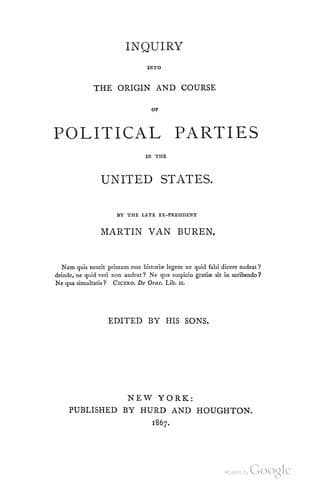
Inquiry Into the Origin and Course of Political Parties in the United StatesVan Buren, Martin
History
Inquiry Into the Origin and Course of Political Parties in the United States
Van Buren, Martin
Political parties -- United States
By these repeated declarations to Mr. Jefferson, Washington only renewed
to a civilian, whose character and position made them the more
significant and impressive, a pledge which he had given to the world at
Newburgh in the presence of the companions of his glory, yet with arms
in their hands--that his name should never be added to the list of those
who, having done much to emancipate a people from thralldom, were the
first to blast their hopes and sacrifice their dearest interests at the
promptings of selfish and unhallowed passions. They only proved that the
flattery of the world during the ten intervening years had not corrupted
his heart nor endangered the observance of a pledge which had derived
its value from the character of the man who gave it, and on whose
continued fidelity to the principle it involved the future liberties and
welfare of his country were in so large a degree dependent.
It has always been believed that if Washington had inclined a favorable
ear to the suggestions of the Newburgh letters, and in due season had
given his name and influence to the counter-revolution they were
intended to promote, it might have been made successful, and the system
which the Revolution had overthrown might have been in some modified
form restored. The disparity between the means which were at his
disposal when propositions looking to such a result were thrown before
the army at Newburgh and those within his reach when the declarations to
Mr. Jefferson were made was not as great as might be supposed. At the
former period it is true that the army of the Revolution was yet in the
field, mortified, irritated, and indeed highly inflamed by the assumed
injustice and ingratitude of their country, and in all probability
prepared to follow his lead in furtherance of any views he might
disclose which did not exceed the proposed limits; and the government to
be overthrown was feeble, distracted, destitute of the sinews of war,
and with but a slight hold upon the confidence and affections of the
people. But it must also be remembered that the fervor and spirit of the
Revolution--that intense hatred of royalty and monarchical institutions
in any shape--which had roused the country to the contest, had as yet in
no sensible degree abated amongst the masses, neither had they
surrendered those sanguine anticipations of the blessings and advantages
of republican government by which their hearts had been fortified and
their arms strengthened for the struggle. That any attempt to bring
about a counter-revolution under such circumstances, however popular the
name and character of him by whom it was sanctioned, or however
imposing the means by which it was sustained, would meet with a
formidable opposition from the great body of the people was certain; and
it was not easy to estimate the nature and extent of the resistance that
might spring from the sources to which I have referred to confront an
Public-domain text, read in full here on John Shaqi.
Reviews
Reviews
No reviews yet
Be the first to share your thoughts on this work.
Elsewhere in the archive
Join the Discussion
Join the discussion
Sign in to leave a comment or review.
Sign InorCreate an account