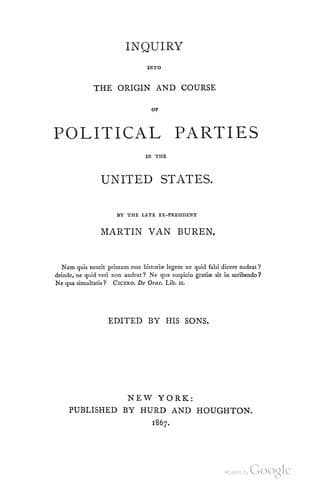
Inquiry Into the Origin and Course of Political Parties in the United StatesVan Buren, Martin
History
Inquiry Into the Origin and Course of Political Parties in the United States
Van Buren, Martin
Political parties -- United States
army which had so lately been the object of their unalloyed admiration
and affection.
In the lapse of time between that period and the one at which Mr.
Jefferson received the assurances he describes great changes had taken
place in respect to all these matters, but, as I have said, not so
adverse as might on first impression be supposed to the practicability
of an attempt such as Washington referred to. The army of the Revolution
had indeed been dissolved, and, in regard to the elements of which it
was principally composed, beyond recall; but its officers, who, next to
Washington, were capable of giving a tone and direction to the spirit of
the troops, were alive, several of them again under his command, not a
few about his person, and all filled with unabated admiration and
affection for their idolized chief. If the account given us by Mr.
Jefferson of the feelings he found most prevalent in our principal
cities and at the seat of government on his return from France and in
his progress to Philadelphia, to take upon himself the office of
Secretary of State, is to be relied upon,--and many important
contemporaneous occurrences corroborate his statement,--sad changes had
taken place in the public opinion and feeling, of absorbing interest in
this connection. "The President," he says, "received me cordially, and
my colleagues and the circle of principal citizens apparently with
welcome. The courtesies of dinner-parties given me, as a stranger newly
arrived among them, placed me at once in familiar society. But I cannot
describe the wonder and mortification with which the table conversations
filled me. Politics were the chief topic, and a preference of kingly
over republican governments was evidently the favorite sentiment." In
his description of what he heard and saw there can be no mistake; but it
is more than probable that changes among the people at large, upon the
point spoken of, had not occurred to any thing like the same extent as
among those portions of society to which he more particularly refers.
Still it is undeniably true that from the influence of examples set by
men in high places, from the difficulties under which the late
government had labored, and from other causes, there had been at that
moment a falling off from the true faith respecting governments and the
administration of them which could now be scarcely credited. Add to
these favoring circumstances the fact that the man, without whose
countenance or coöperation no reactionary attempt would have been
thought of even by the rankest advocate for monarchical institutions,
was at the head of the Government to be overthrown, and the unquestioned
object of the national confidence and affection, and the scheme, with
his coöperation, was not likely to be then regarded as so impracticable
as it would now certainly be considered. If such a work were at this day
thought of by any man or men, however elevated in position or loved by
Public-domain text, read in full here on John Shaqi.
Reviews
Reviews
No reviews yet
Be the first to share your thoughts on this work.
Elsewhere in the archive
Join the Discussion
Join the discussion
Sign in to leave a comment or review.
Sign InorCreate an account