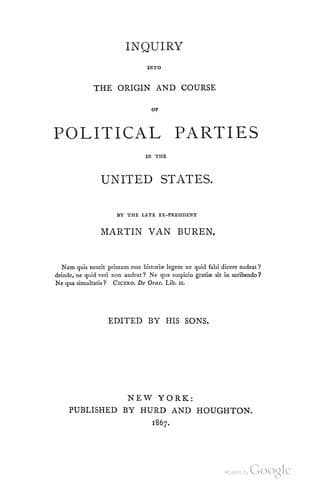
Inquiry Into the Origin and Course of Political Parties in the United StatesVan Buren, Martin
History
Inquiry Into the Origin and Course of Political Parties in the United States
Van Buren, Martin
Political parties -- United States
It is a striking fact in our political history that the sagacious
leaders of the Federal party, as well under that name as under others by
which it has at different times been known, have always been desirous to
bring every usage or plan designed to secure party unity into disrepute
with the people, and in proportion to their success in that has been
their success in the elections. When they have found such usage too
strong to be overthrown for the time being, they have adopted it
themselves, but only to return to their denunciations of it after every
defeat. It would, on first impression, seem that a practice which is
good for one political party must be good for another; but when the
matter is more closely looked into, it will be discovered that the
policy of the Federal leaders referred to, like most of the acts of
those far-seeing men, rested upon substantial foundations. It
originated, beyond doubt, in the conviction, on the part of the early
Federalists, that a political organization in support of the particular
principles which they advocated, and to which they intended to adhere,
did not stand as much in need of extraneous means to secure harmony in
its ranks as did that of their opponents.
The results of general elections for more than half a century have
served to confirm this opinion. With the exception of a single instance,
susceptible of easy explanation, the Republican, now Democratic party,
whenever it has been wise enough to employ the caucus or convention
system, and to use in good faith the influence it is capable of
imparting to the popular cause, has been successful, and it has been
defeated whenever that system has been laid aside or employed unfairly.
With the Federal party and its successors the results have been widely
different; with or without the caucus system they have generally found
no difficulty in uniting whenever union promised success.
Why is it that a system or practice open to both parties, occasionally
used by both, and apparently equally useful to both, is in fact so much
less necessary to one than to the other? If this consequence springs
from a corresponding difference in the principles for the defense and
spread of which they have respectively been formed, what are those
principles, whence are they derived, and what is their history?
These are grave questions, which have often presented themselves to the
minds of our public men, and to answer which satisfactorily is neither
an easy nor a short task.
Public-domain text, read in full here on John Shaqi.
Reviews
Reviews
No reviews yet
Be the first to share your thoughts on this work.
Join the Discussion
Join the discussion
Sign in to leave a comment or review.
Sign InorCreate an account