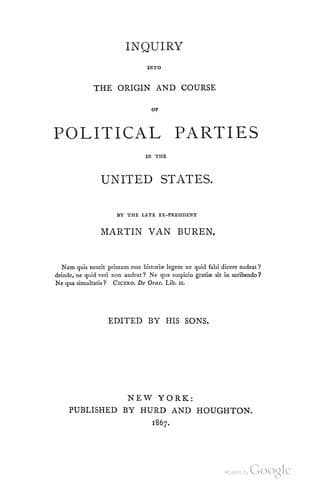
Inquiry Into the Origin and Course of Political Parties in the United StatesVan Buren, Martin
History
Inquiry Into the Origin and Course of Political Parties in the United States
Van Buren, Martin
Political parties -- United States
The Convention that framed the Constitution was well aware that the
portion of its labors which related to the extent of the powers to be
given to the new government was that upon which the public mind was
most sensitive. It was not ignorant how far the apprehensions of the
people upon that point had, through the entire period of our colonial
history, prevented the establishment of any general government, and even
the institution of one since the Declaration of Independence that was
adequate to the necessities of the country. It knew that the powers
given to Congress, particularly, would be the part of the Constitution
to which the attention of the friends of the State governments would be
directed, and upon which their opposition would be most likely to arise.
Understanding these things, the Convention, with that good sense and
prudence by which its entire course was so greatly distinguished,
bestowed upon that branch of its business the utmost care and
circumspection. Instead of describing the power given to Congress in
general terms, as was done by Hamilton, in the plan submitted by him for
its adoption,--viz.: "To pass all laws which they shall judge necessary
to the common defense and general welfare of the Union,"--by which much
would of necessity be left to the discretion of those who were to
execute the power, the Convention specified the powers it intended to
grant under seventeen heads, and described them in the simplest and
plainest language, so that none should be at a loss to understand their
import. So well was this design executed that no room for doubt or cavil
remained to those who had no other desire than to arrive at the meaning
of the framers of the Constitution.
Here the Convention might have stopped, for no implication could have
been more unavoidable than that Congress should have the right to
promulgate the rules they adopted by the enactment of laws. But as if
aware of the uses which the able men from whom it apprehended opposition
might make of the fact that a necessity of a resort to implication had
been left by the instrument, it granted that power also in express
terms. The principal part of that clause was moreover designed to
constitute Congress the law-maker for the other great departments of the
government, and to exclude the idea that they should also have the power
of legislation.
Having thus, as it thought, guarded the work of its hands from
misrepresentation or misinterpretation upon what it justly considered
the most delicate and, if disregarded, the most vulnerable point, and
having framed a Constitution with which all friends to republican
principles ought to be satisfied, the Convention appealed with
confidence to the ratifying conventions, and in doing so it did no more
than justice to those bodies,--the instrument, thus guarded, was
ultimately ratified by the votes of all the States.
Public-domain text, read in full here on John Shaqi.
Reviews
Reviews
No reviews yet
Be the first to share your thoughts on this work.
Elsewhere in the archive
Join the Discussion
Join the discussion
Sign in to leave a comment or review.
Sign InorCreate an account