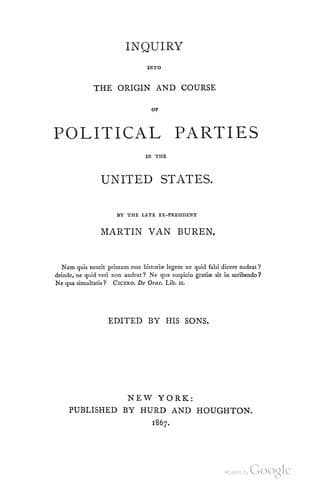
Inquiry Into the Origin and Course of Political Parties in the United StatesVan Buren, Martin
History
Inquiry Into the Origin and Course of Political Parties in the United States
Van Buren, Martin
Political parties -- United States
If Hamilton, either in the articles of the "Federalist," to which he
largely contributed, or on the floor of the Convention of Ratification,
of which he was a member, had only countenanced that construction of the
Constitution which he set up for it as Secretary of the Treasury, or if
in any other way a suspicion had been produced that it was intended to
give that instrument such a construction after its ratification, its
rejection would have been inevitable. No one who has studied the state
of the public mind at that period can for a moment doubt that this would
have been the result. Such was the true character of the Constitution
which the people of the United States intended to establish, and thought
they had established, and such were the circumstances under which it was
ratified.
Hamilton was placed by Washington virtually at the head of his
administration; for, although the Secretary of State has, since that
period, been regarded in that light, no such impression had then
obtained, and in the government of Great Britain, to which attention
had been most directed, it was otherwise. The Treasury Department
wielded infinitely the most influence, and the superior confidence of
the President in the incumbent decided the point of priority, at least
for the time being. Perhaps the only question in respect to Hamilton
upon which there has never been any diversity of sentiment was in regard
to his talents. That they were of the highest order was the opinion of
all who knew him. Jefferson scarcely ever spoke of him in his letters to
Madison without admonishing him of the extraordinary powers of his mind,
and in one of them he says,--"Hamilton is really a Colossus to the
Anti-Republican party; without numbers he is a host in himself. In truth
when he comes forward there is nobody but yourself (Madison) that can
meet him." When I was Minister of the United States in England I saw
much of Prince Talleyrand, then French Ambassador at the same Court, and
enjoyed relations of marked kindness with him. In my informal visits to
him we had long and frequent conversations, in which Hamilton, his
acquaintance with him in this country, and incidents in their
intercourse, were his favorite themes. He always spoke with great
admiration of his talents, and during the last evening that I spent with
him he said that he regarded Hamilton as the ablest man he became
acquainted with in America,--he was not sure that he might not add
without injustice, or that he had known in Europe.[18] With such
advantages, greater at that time certainly than the public service of
any country afforded to any other man, it is difficult to conceive of a
more commanding position than that which he occupied. With a mind that
dwelt habitually upon great ideas, the political career of such a man
could not fail to produce important results for good or for evil. It
must not, however, be forgotten, for it is a truth which exerted a
Public-domain text, read in full here on John Shaqi.
Reviews
Reviews
No reviews yet
Be the first to share your thoughts on this work.
Elsewhere in the archive
Join the Discussion
Join the discussion
Sign in to leave a comment or review.
Sign InorCreate an account