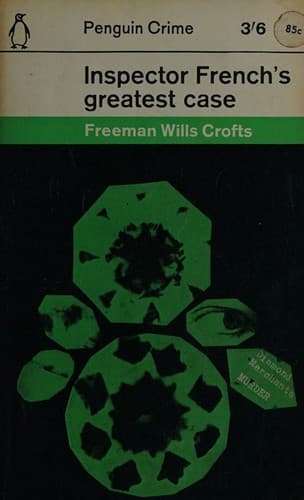
Detective and mystery stories; French, Joseph (Fictitious character) -- Fiction; Police -- Great Britain -- Fiction
On the evening of his death it had been arranged that he would sit with
Mrs. Gething, in order to allow his daughter to attend a social
connected with the choir of the church to which she belonged. But that
evening he came home more worried and upset than she had ever seen him,
and he had told her with many expressions of regret that some unexpected
work which had just come in would require his presence that evening in
the office, and that unless she was able to get some one else to look
after her mother, she would have to give up her social. He had been too
nervous and ill at ease to make a good meal, and had gone off about
eight o’clock, saying he did not know at what hour he would be back.
That was the last time she had seen him alive, and she had heard nothing
of him until the policeman had come with his terrible news about
half-past eleven.
Miss Gething was clearly at one with her sister in her admiration and
affection for her father, and French recognised that she was as
mystified as to his death as he was himself. Seeing that he could learn
no more, he presently took his leave, with renewed expressions of
sympathy for her trouble.
When he reached the Yard he found that enlarged photographs of the
various finger prints he had discovered were ready, and he sat down with
some eagerness to compare the impressions with those on his cards. He
spent some time counting and measuring lines and whorls, and at last
reached the following conclusions. All the finger marks on the safe,
both inside and out, belonged either to Mr. Duke or to Mr. Gething, the
majority being the latter’s; the mark on the handle of the coal shovel
was Mr. Gething’s, and the remaining prints were those of various
members of the office staff. His hopes of help from this source were
therefore dashed.
With a sigh he looked at his watch. There would be time before the
inquest to make some inquiries as to the truth of Orchard’s statement of
his movements on the previous evening. Half an hour later he had found
the man with whom the clerk had dined in Ilford, and he fully
substantiated the other’s story. Orchard was therefore definitely
eliminated from the inquiry.
The proceedings before the Coroner were practically formal. Orchard, Mr.
Duke, and Constable Alcorn told their stories, and with very little
further examination were dismissed. French and the local superintendent
watched the case on behalf of the police, but did not interfere, and the
next of kin of the deceased were not legally represented. After half an
hour, the Coroner summed up, and the jury without retiring brought in
the obvious verdict of wilful murder against some person or persons
unknown.
That evening, when French had dined and had settled himself before the
fire in his sitting-room with a pipe between his lips and his notebook
on the table at his elbow, he set himself to take mental stock of his
position and get a clear grasp of his new problem.
Public-domain text, read in full here on John Shaqi.
Reviews
Reviews
No reviews yet
Be the first to share your thoughts on this work.
Join the Discussion
Join the discussion
Sign in to leave a comment or review.
Sign InorCreate an account