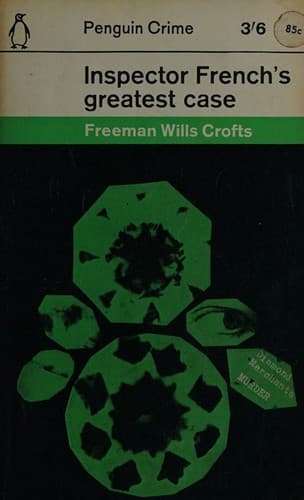
Detective and mystery stories; French, Joseph (Fictitious character) -- Fiction; Police -- Great Britain -- Fiction
Next, there was the open way in which Gething returned to the office.
Had he intended to burgle the safe, would he not have kept the fact of
his visit a secret? Yet he told the office boy he was returning when
instructing him to keep up the fire in the inner office, and he also
mentioned it to his daughter when discussing her proposed choir meeting.
Further, there was this matter of the fire in the private office. If
Gething was going to rob the safe, what was the fire for? It was not
merely that he had instructed the office boy to keep it up. He had
himself afterwards put coal on, as was evidenced by his finger marks on
the handle of the shovel. The robbing of the safe would have been a
matter of minutes only. Did the episode of the fire not look as if
Gething really was employed at some exceptional work, as he had stated
to his daughter?
On the whole, French thought, the evidence for Gething’s guilt was
stronger than that against it, and he began to form a tentative theory
somewhat as follows: That Gething, finding the conditions of his home
life onerous beyond further endurance, and realising the unusually
valuable deposit in the safe, had decided to help himself, probably to a
quite small portion, knowing that the loss would fall, not on Mr. Duke,
but on the insurance company; that he had obtained an impression of the
key from which he had had a duplicate made; that he had invented the
business in the office as a safeguard should he be accidentally found
there during the evening; that he _had_ been found there, probably
accidentally, by some one who, seeing the possibilities opening out in
front of him, had been swept off his feet by the sudden temptation and
had killed the old man and made off with the swag.
This theory seemed to meet at least most of the facts. French was not
pleased with it, but it was the best he could produce, and he decided to
adopt it as a working hypothesis. At the same time he kept an open mind,
recognising that the discovery of some fresh fact might put a different
complexion on the whole affair.
Next morning he put some obvious investigations in train. By astute
indirect inquiries, he satisfied himself that neither Mr. Gething nor
any other worker in the Duke & Peabody office had the technical skill to
have cut the key, and he put a man on to try and trace the professional
who had done it. He issued a description of the stolen diamonds to the
British and Dutch police, as well as to certain dealers from whom he
hoped to obtain information of attempted sales. He saw that a general
advice was sent to the banks as to the missing notes, and he searched,
unsuccessfully, for any person who might have known of the treasure and
who was unable satisfactorily to account for his movements on the night
of the murder.
Public-domain text, read in full here on John Shaqi.
Reviews
Reviews
No reviews yet
Be the first to share your thoughts on this work.
Join the Discussion
Join the discussion
Sign in to leave a comment or review.
Sign InorCreate an account