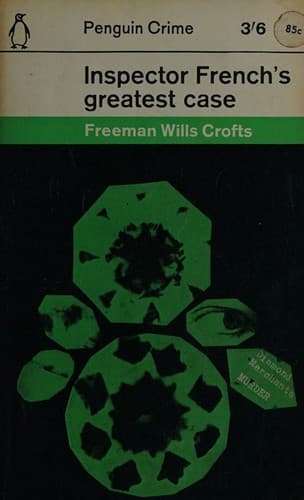
Detective and mystery stories; French, Joseph (Fictitious character) -- Fiction; Police -- Great Britain -- Fiction
“No, no,” French answered smoothly, “I have not expressed myself
clearly. Neither of us is making any accusation. We are simply
consulting together in a private, and, I hope, a friendly way, each
anxious only to find out the truth. Any suggestion may be helpful. If I
make the suggestion that Mr. Vanderkemp is the guilty man in order to
enable us to discuss the possibility, it does not follow that either of
us believes it to be true, still less that I should act on it.”
“I am aware of that, but I don’t make any such suggestion.”
“Then I do,” French declared, “simply as a basis for discussion. Let us
suppose then, purely for argument’s sake, that Mr. Vanderkemp decides to
make some of the firm’s wealth his own. He is present when the stones
are being put into the safe, and in some way when Mr. Duke’s back is
turned, he takes an impression of the key. He crosses to London, either
finds Gething in the office or is interrupted by him, murders the old
man, takes the diamonds, and clears out. What do you think of that?”
“What about the letter?”
“Well, that surely fits in? Mr. Vanderkemp must leave this office in
some way which won’t arouse your suspicion or cause you to ask questions
of the London office. What better way than by forging the letter?”
Mr. Schoofs swore for the second time. “If he has done that,” he cried
hotly, “let him hang! I’ll do everything I can, Inspector, to help you
to find out, and that not only on general grounds, but for old Gething’s
sake, for whom I had a sincere regard.”
“I thought you would feel that way, sir. Now to return to details. I
suppose you haven’t the envelope that letter came in?”
“Never saw it,” Mr. Schoofs replied. “The clerk who opened it would
destroy it.”
“Better have the clerk in, and we’ll ask the question.”
Mr. Schoofs made a sudden gesture.
“By Jove!” he cried. “It was Vanderkemp himself. He acts as head clerk
when he is here.”
“Then we don’t get any evidence there. Either the letter came through
the post, in which case he destroyed the envelope in the usual way, or
else he brought the letter to the office and slipped it in among the
others.”
French picked up the letter again. Experience had taught him that
typescript could be extremely characteristic, and he wondered if this in
question could be made to yield up any of its secrets.
It certainly had peculiarities. The lens revealed a dent in the curve of
the n, where the type had evidently struck something hard, and the tail
of the g was slightly defective.
French next examined the genuine letters, and was interested to find
their type showed the same irregularities. It was therefore certain that
the forged letter had been typed in the London office.
Public-domain text, read in full here on John Shaqi.
Reviews
Reviews
No reviews yet
Be the first to share your thoughts on this work.
Join the Discussion
Join the discussion
Sign in to leave a comment or review.
Sign InorCreate an account