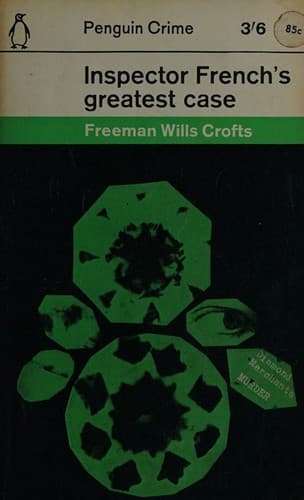
Detective and mystery stories; French, Joseph (Fictitious character) -- Fiction; Police -- Great Britain -- Fiction
“I’ll tell you what I know, Inspector,” he said earnestly. “Whether, if
you are going to arrest me, I am wise or foolish, I don’t know. But I
can at least assure you that it is the literal truth.”
He looked at the Inspector, who nodded approval.
“Of course I can’t advise you, Mr. Vanderkemp,” he remarked, “but all
the same I believe you are doing the wise thing.”
“I am in a difficulty,” Vanderkemp went on, “as I don’t know how much of
the circumstances you are familiar with. It would therefore be better if
you would ask me questions.”
“I shall do so, but first I should like your own statement. I am aware
of your name and position in the firm. Also that Mr. Schoofs received a
letter on the 21st of last month, asking him to send you to London to
undertake an important commission in Sweden. Also that you left your
lodgings in the Kinkerstraat at 8.30 on the evening of the 24th. I have
since learned certain other facts as to your subsequent movements, which
I need not mention at the moment. What I want you now to do is to let me
have a detailed account of your experiences from the moment of your
leaving your lodgings until the present time.”
“I will do so.” Vanderkemp spoke eagerly, as if now anxious to get
through with the matter. “But there is one thing which comes earlier in
point of time which I must mention. You have probably heard of it from
Mr. Duke, but I shall tell you anyway. I mean about my further
instructions as to my London visit—the private instructions. You have
seen a copy of them?”
French, always cautious, was not giving away information. He wondered to
what the other was referring, but merely said, “Assume I have not, Mr.
Vanderkemp. It is obvious that I must check your statement by the
information in my possession.”
“Well, then, though you probably know it already, I may tell you I
received additional instructions about my visit. Mr. Duke wrote me a
private letter, addressed to my lodgings, in which he told me—but I
have it here, and you can see it for yourself.”
He took an envelope from his pocketbook and passed it across. It
contained a note almost identical in appearance with the forged one
which Mr. Schoofs had received. It was typewritten on a sheet of the
firm’s cheaper memorandum paper, with the same kind of type and the same
coloured ribbon. Examination with the lens showed the same defects in
the n and the g, the signature was obviously forged, and the back of the
sheet was marked from a heavy touch. Evidently both letters had been
written by the same person, and on the Hatton Garden machine. The note
read:
Public-domain text, read in full here on John Shaqi.
Reviews
Reviews
No reviews yet
Be the first to share your thoughts on this work.
Join the Discussion
Join the discussion
Sign in to leave a comment or review.
Sign InorCreate an account